

Dividend Kings vs Dividend Aristocrats: Key Differences
When it comes to dividend-focused investing, Dividend Kings and Dividend Aristocrats are two standout groups. Here’s a quick breakdown of their differences:
- Dividend Kings: Companies with 50+ years of consecutive dividend growth. No requirement to be in the S&P 500, and they include companies of all sizes. By 2025, there were 56 Dividend Kings.
- Dividend Aristocrats: Companies in the S&P 500 with 25+ years of consecutive dividend growth. They must have a $3 billion+ market cap and meet liquidity standards. As of 2025, there were 69 Dividend Aristocrats.
Quick Comparison
| Feature | Dividend Kings | Dividend Aristocrats |
|---|---|---|
| Years of Dividend Growth | 50+ | 25+ |
| Index Requirement | None | Must be in S&P 500 |
| Market Cap | No minimum | $3B+ |
| Liquidity | No requirement | $5M+ daily trading value |
| Number of Companies | 56 (2025) | 69 (2025) |
| Primary Sector | Consumer Staples (28%) | Industrials (24%) |
Which should you choose? Dividend Kings are great for steady income and stability, while Dividend Aristocrats offer a mix of income and growth. Combining both can provide a balanced portfolio.
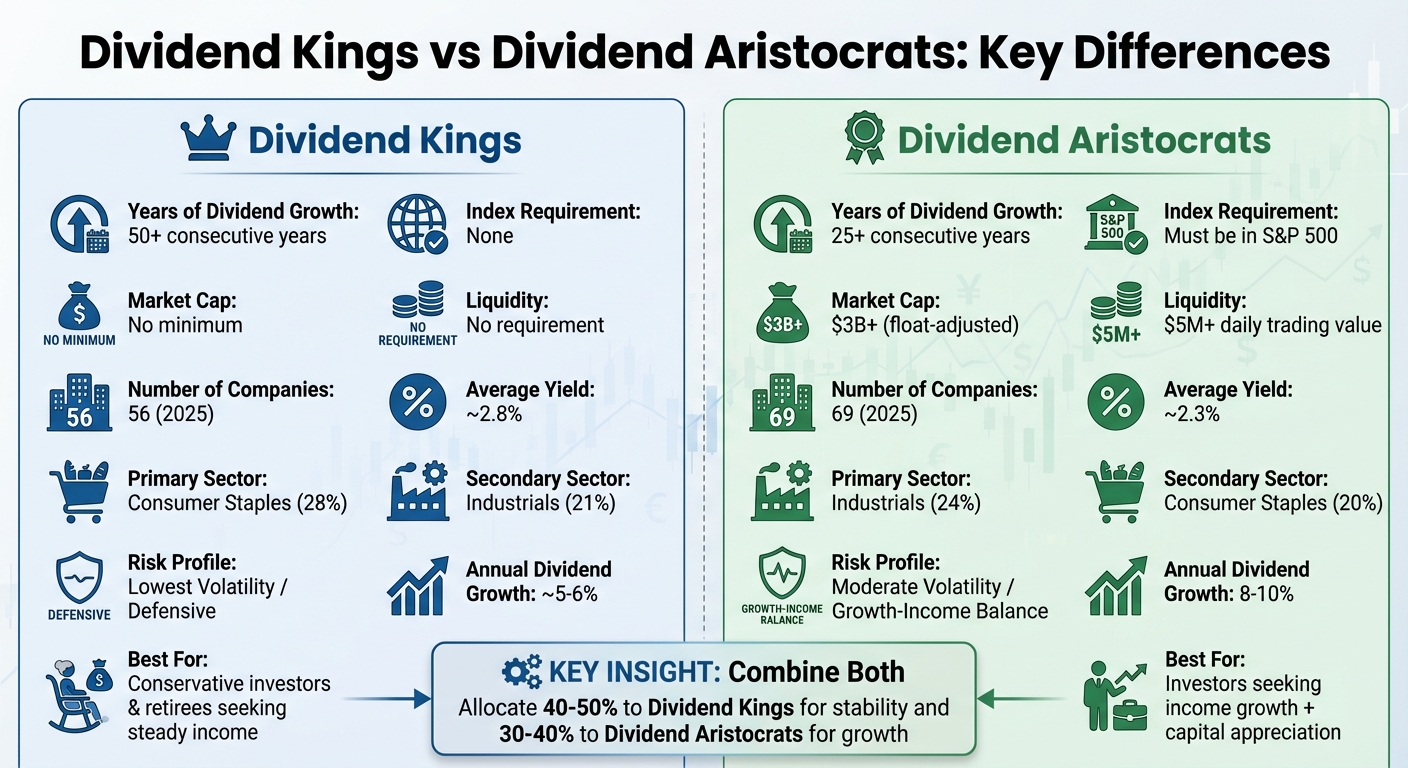
Dividend Kings vs Dividend Aristocrats Comparison Chart
Qualification Requirements and Definitions
Dividend Aristocrats: Requirements and Features
To earn the Dividend Aristocrat title, a company must meet a few specific criteria: it must be part of the S&P 500, have increased its dividend for at least 25 consecutive years, maintain a $3 billion float-adjusted market cap, and achieve an average daily trading value of at least $5 million. These standards ensure that only highly liquid and actively traded blue-chip stocks make the cut. As of 2025, 69 companies hold this prestigious status. A standout example is Procter & Gamble (PG), which has impressively raised its dividend for 70 consecutive years as of early 2026.
On the other hand, Dividend Kings raise the bar even higher, requiring an extended track record of dividend growth.
Dividend Kings: Requirements and Features
Dividend Kings set themselves apart by demanding an even longer streak of dividend increases – 50 consecutive years. This achievement reflects a company’s ability to weather a variety of economic challenges over decades.
"The 50-year threshold represents exceptional resilience. Companies maintaining this streak have navigated multiple recessions, currency crises, technological disruptions, and fundamental shifts in consumer behavior." – Kestutis Balciunas
Unlike Dividend Aristocrats, Dividend Kings are not bound by S&P 500 membership, market cap minimums, or liquidity thresholds. This flexibility allows mid-cap and smaller companies to join the ranks, provided they demonstrate long-term financial discipline. As of late 2025, 56 companies hold the title of Dividend King. Leading the pack is American States Water (AWR), boasting an incredible 72 consecutive years of dividend increases as of January 2026. Johnson & Johnson (JNJ) also retains its King status, even after spinning off its consumer health division, Kenvue, in 2023. Interestingly, 25 of the 57 Dividend Kings have market capitalizations under $10 billion, proving that smaller companies can achieve impressive longevity. However, the list saw some losses in 2024 when 3M (MMM) and Leggett & Platt ended their streaks by cutting dividends.
Side-by-Side Comparison of Requirements
The differences between Dividend Aristocrats and Dividend Kings highlight their unique investment characteristics:
| Feature | Dividend Aristocrats | Dividend Kings |
|---|---|---|
| Dividend Streak | 25+ consecutive years | 50+ consecutive years |
| Index Requirement | Must be in the S&P 500 | No index requirement |
| Market Cap | Minimum $3 billion (float-adjusted) | No minimum |
| Liquidity | Minimum $5 million daily trading value | No minimum |
| Company Size | Exclusively large-cap | Ranges from mega to small-cap |
Some companies, like Procter & Gamble and Coca-Cola, qualify for both categories by meeting the 50-year dividend growth requirement while maintaining S&P 500 membership. However, others, such as Farmers & Merchants Bancorp (FMCB) – with a 60-year streak – trade over-the-counter and fail to meet the S&P 500 criteria, excluding them from the Aristocrat list. This distinction means that while every Dividend King meets the 25-year growth requirement, not all qualify as Aristocrats due to additional size or index-related restrictions.
Market Capitalization and Sector Distribution
Market Capitalization: Large-Cap vs. Mixed Cap
The S&P 500 membership requirement ensures that Dividend Aristocrats are exclusively large-cap companies. To qualify, a company must have a minimum float-adjusted market cap of $3 billion, though most Aristocrats far exceed that, with market caps typically above $5 billion. These are some of the largest, most established companies in the U.S. market.
Dividend Kings, on the other hand, operate under a different set of rules. With no ties to an index or strict market cap requirements, the Kings list includes companies of various sizes. It features mega-cap giants like Johnson & Johnson (market cap: $527 billion), mid-sized firms such as Target (market cap: $50.4 billion), and even smaller players like Farmers & Merchants Bancorp, which trades over-the-counter. This flexibility allows investors to access dividend growers that may not meet the size criteria for inclusion in the S&P 500 but have proven their financial discipline over five decades. These differences in size influence factors like liquidity, stability, and income reliability. Let’s take a closer look at how these characteristics shape sector distribution within the two groups.
Sector Distribution and Diversification
Sector allocation is another key area where Dividend Aristocrats and Dividend Kings differ. The Aristocrats maintain a more balanced spread across industries, with Industrials leading at 24%, followed by Consumer Staples at 20%. The S&P 500 index imposes a 30% sector cap during rebalancing, which prevents over-concentration and ensures a diverse mix, including sectors like Real Estate (3%).
In contrast, Dividend Kings have a stronger focus on defensive sectors. Consumer Staples dominate at 28%, and Industrials make up 21%, together accounting for nearly half the list. As Jason Hall from The Motley Fool points out:
"The industrial and consumer goods sectors make up more than half of the 2025 Dividend Kings list. This shouldn’t be a surprise. Companies in these sectors tend to pay dividends and raise their prices with inflation".
The Kings list also has minimal representation in Real Estate and Technology, reflecting a preference for mature, cash-generating businesses in industries that tend to be more resilient during economic downturns.
| Sector | Dividend Kings | Dividend Aristocrats |
|---|---|---|
| Consumer Staples | 28% | 20% |
| Industrials | 21% | 24% |
| Financials | 14% | 10% |
| Healthcare | 12% | 12% |
| Materials | 11% | 13% |
| Utilities | 8% | 7% |
| Energy | 4% | 9% |
| Real Estate | ~2% | 3% |
| Technology | ~2% | 1% |
Risk Profile and Historical Performance
Dividend Kings: Lower Volatility and Stability
The structural makeup of Dividend Kings sets them apart, shaping their risk profile and market behavior. These stocks represent the most stable option among dividend-paying investments. Their 50-year streak of increasing dividends highlights their resilience in the face of economic turbulence:
"The 50-year threshold represents exceptional resilience. Companies maintaining this streak have navigated multiple recessions, currency crises, technological disruptions, and fundamental shifts in consumer behavior."
This impressive track record translates into lower beta values and greater price stability. The heavy focus on defensive sectors acts as a shield during market downturns since these companies produce essential goods and services that remain in demand regardless of economic conditions.
However, this defensive strategy often comes with slower growth. In recent years, many Dividend Kings have lagged behind the tech-heavy S&P 500 as investors gravitated toward high-growth sectors like AI. Still, they offer consistent annual dividend growth, averaging around 5% to 6% over the past decade. Up next, let’s explore how Dividend Aristocrats stack up in terms of risk and returns.
Dividend Aristocrats: Broader Risk-Return Profile
Dividend Aristocrats strike a balance between risk and reward, sitting between the ultra-stable Dividend Kings and the broader market. While they offer solid downside protection compared to the S&P 500, they tend to show higher volatility due to their exposure to both cyclical and defensive industries.
One unique risk tied to Dividend Aristocrats stems from their S&P 500 membership requirement. If a company’s market cap drops below the index threshold or it is removed for other reasons, it loses its Aristocrat status – even if it continues to raise dividends. This is a challenge Dividend Kings don’t face.
On the flip side, the diversified sector exposure of Dividend Aristocrats opens the door to industries with higher growth potential. This can lead to stronger capital appreciation while still providing dividend income. That said, as of August 28, 2023, the Dividend Aristocrats index had underperformed the S&P 500 in 1-year, 3-year, and 5-year annualized returns.
Performance Comparison Table
| Metric | Dividend Kings | Dividend Aristocrats |
|---|---|---|
| Years of Dividend Growth | 50+ Years | 25+ Years |
| Number of Companies | 56 (as of 2026) | 69 (as of 2025) |
| Average Yield | ~2.8% | ~2.3% |
| Median Yield | 2.5% | 2.1% |
| Risk Profile | Lowest Volatility / Defensive | Moderate Volatility / Growth-Income Balance |
| Primary Sector | Consumer Staples (28%) | Industrials (24%) |
| Secondary Sector | Industrials (21%) | Consumer Staples (20%) |
| Market Cap Requirement | None | $3B+ (S&P 500 members) |
| Annual Dividend Growth | ~5-6% (last decade) | Varies |
sbb-itb-484be5d
Dividend Kings, Aristocrats, and Champions (EXPLAINED)
Income Growth and Investor Fit
When evaluating dividend stocks, it’s essential to consider how income growth aligns with different investor goals and strategies.
Income Growth Potential: Kings vs. Aristocrats
The growth of dividend income varies significantly between Dividend Kings and Dividend Aristocrats.
- Dividend Kings tend to offer slower but steadier growth, with annual earnings growth typically ranging from 2% to 4%. These companies, having already captured most of their market potential, focus on maintaining their long-standing dividend streaks. In fact, some Kings increase dividends by as little as 1% annually, simply to preserve their impressive records.
- On the other hand, Dividend Aristocrats generally deliver faster earnings growth, often between 8% and 10% annually, which allows for greater capital appreciation. Stocks in the early stages of Aristocrat status (10 to 24 years of growth) often strike the best balance for total returns, as they still have room to expand compared to companies with 50+ years of growth. A useful metric for evaluating these stocks is the Chowder Rule: adding the 5-year Dividend Growth Rate to the current yield. If the total exceeds 12%, it indicates a strong potential to outpace inflation.
Which Investors Should Choose Each Category
The choice between Dividend Kings and Aristocrats often comes down to an investor’s priorities:
- Dividend Kings are ideal for conservative investors or retirees who rely on steady income. With an average yield of 2.8%, these stocks offer reliability and are heavily concentrated in recession-resistant sectors. This makes them a dependable choice during economic downturns.
- Dividend Aristocrats are better suited for investors seeking both income growth and capital appreciation. Their exposure to dynamic industries like Technology (1%) and Real Estate (3%) offers additional growth opportunities. These stocks are particularly effective for long-term investors who can reinvest dividends, harnessing the power of compounding to grow their portfolios over time.
Understanding these distinctions helps investors tailor their portfolios to meet specific financial goals.
Combining Kings and Aristocrats in a Portfolio
You don’t have to limit yourself to one category. A Barbell Strategy can provide an effective balance by allocating:
- 40% to 50% of your portfolio to "Fortress" Dividend Kings for stability and income preservation.
- 30% to 40% to "Accelerator" Dividend Aristocrats, which offer higher dividend growth rates.
This approach combines the defensive strength of Kings with the growth potential of Aristocrats, creating a well-rounded portfolio.
When implementing this strategy, focus on quality: avoid Dividend Kings with growth rates under 3% and prioritize Aristocrats with at least 7% growth to maximize yield-on-cost. For most investors, allocating 15% to 30% of a dividend-growth portfolio to these elite categories can establish a stable, growth-oriented income foundation. Additionally, this combination helps diversify sector risks, as Kings are more defensive while Aristocrats include industries with cyclical and growth characteristics.
Conclusion: Choosing Between Dividend Kings and Dividend Aristocrats
When deciding between Dividend Kings and Dividend Aristocrats, it all comes down to your investment goals. Are you looking for steady, reliable income? Or do you want a mix of growth and income? Both groups play unique roles in building a strong portfolio.
Dividend Kings are all about stability. With over 50 years of consistent dividend increases, they’re perfect for conservative investors who prioritize preserving capital and generating dependable income. This makes them especially appealing to retirees or those who prefer a low-risk approach.
On the other hand, Dividend Aristocrats bring a different kind of value. Since they must be part of the S&P 500, these companies are large-cap, highly liquid, and often leaders in their industries. They also provide better sector diversification and exposure to growth-focused industries. This makes them a solid choice for investors looking to balance income with the potential for capital appreciation.
The best strategy? Combine the strengths of both. By blending Dividend Kings’ stability with the growth opportunities of Dividend Aristocrats, you can create a diversified portfolio that captures the benefits of both approaches. However, don’t forget to dig into the details. Even companies with decades of dividend increases can falter. For example, 3M and Leggett & Platt cut their dividends in 2024 despite their long histories. Always ensure dividends are backed by strong free cash flow and a healthy balance sheet, no matter the label.
FAQs
What are the advantages of investing in both Dividend Kings and Dividend Aristocrats?
Investing in Dividend Kings means putting your money into companies that have consistently increased their dividends for at least 50 years. These businesses showcase remarkable financial strength, steady earnings growth, and a dedication to rewarding shareholders. For those seeking reliable, long-term income, these companies are a solid choice.
Meanwhile, Dividend Aristocrats consist of S&P 500 companies that have raised their dividends for at least 25 years. This group offers a wider range of stocks, giving you access to more sectors and potential growth opportunities, all while maintaining a strong track record of dividend reliability. By blending Dividend Kings and Dividend Aristocrats in your portfolio, you can strike a balance between the stability of well-established companies and the growth potential of a more diversified selection.
How do Dividend Kings continue raising dividends during economic downturns?
Dividend Kings manage to keep their dividend growth steady even during tough economic periods by leaning on strong competitive advantages and careful financial management. These companies often benefit from factors like brand loyalty, operating in regulated industries, or facing high barriers to entry – elements that help them generate steady and reliable cash flow. This dependable income stream allows them to focus on dividends while steering clear of low-yield investments.
On top of that, Dividend Kings usually have healthy balance sheets and diverse revenue sources, which provide a safety net when one area of the business faces challenges. By consistently maintaining or increasing their free cash flow, they ensure that dividend payments remain uninterrupted. Their long-standing history of dividend growth also appeals to income-focused investors, reinforcing their financial stability even during uncertain times.
What makes a company a Dividend King but not a Dividend Aristocrat?
A company earns the title of a Dividend King by increasing its dividend payouts for an impressive 50 consecutive years or more. On the other hand, Dividend Aristocrats need 25 straight years of dividend growth but must also be listed in the S&P 500 index. Because Dividend Kings don’t have the S&P 500 membership requirement, a company can hit the 50-year mark without necessarily qualifying as an Aristocrat.