

REITs vs Dividend Stocks: Which Pays Better Returns?
Looking to boost your passive income? REITs and dividend stocks are two popular options. Here’s the key difference: REITs focus on generating higher immediate income through real estate, while dividend stocks often provide lower yields but offer better long-term growth potential through reinvested earnings. Both have pros and cons depending on your financial goals, tax situation, and market conditions.
Key Takeaways:
- REITs: Higher yields (3.9% average in 2026), steady cash flow, tax-efficient in retirement accounts, but sensitive to interest rate changes and taxed as ordinary income.
- Dividend Stocks: Lower yields (1.1% S&P 500 average), better long-term growth, tax-favored qualified dividends, and more resilient in rising-rate environments.
Quick Comparison
| Feature | REITs | Dividend Stocks |
|---|---|---|
| Average Yield (2026) | 3.9% | 1.1% (S&P 500 average) |
| Tax Treatment | Ordinary income (up to 37%) | Qualified dividends (0%-20%) |
| Volatility | Lower (Beta: 0.75) | Moderate (Beta: 0.94) |
| Growth Potential | Limited by 90% payout rule | Higher due to reinvestment |
| Best For | Immediate income | Long-term wealth building |
Bottom Line: REITs excel at providing higher income now, while dividend stocks are better for growing wealth over time. Your choice depends on your income needs, tax situation, and market outlook.
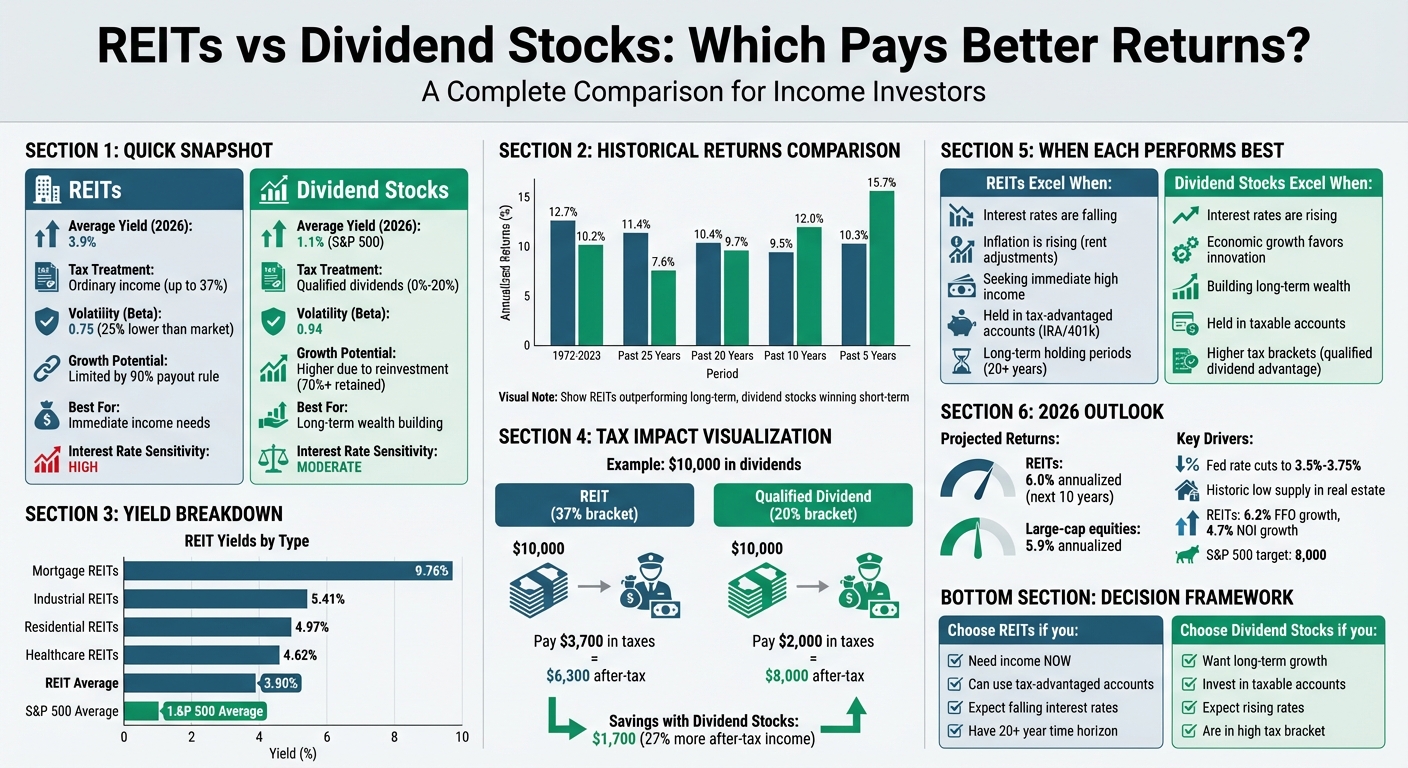
REITs vs Dividend Stocks Comparison: Yields, Returns, Taxes and Risk Metrics
Dividend Stocks vs REITs for Safe Cash Flow
sbb-itb-484be5d
Historical Returns: REITs vs Dividend Stocks
Looking at historical data, REITs (Real Estate Investment Trusts) have consistently outperformed the broader market over the past five decades. From 1972 to 2023, the FTSE Nareit All Equity REITs index delivered an impressive 12.7% annual return, outpacing the S&P 500’s 10.2% return during the same period. This performance gap becomes even more striking over specific timeframes. For instance, in the last 25 years, REITs achieved an annual return of 11.4%, well above the S&P 500’s 7.6%. Below, we dive deeper into the performance of each asset class.
REIT Performance from 1972 to 2023
Over the long haul, REITs have shown consistent strength. They outperformed the broader market in 82% of rolling 30-year periods. Nicole Funari, Vice President of Research at Nareit, captures this trend perfectly:
The longer the time horizon, the more often REITs have outperformed stocks.
Individual REITs have also delivered strong results. Realty Income (O), for example, has provided a 13.7% annualized return since 1994, with 112 consecutive quarters of dividend increases. Meanwhile, Extra Space Storage (EXR) achieved a staggering 2,400% total return over 20 years, driven by 10.3% annual dividend growth.
REITs have also demonstrated lower volatility compared to stocks, making them a more stable option for long-term investors. For 10-year rolling returns, REITs had a standard deviation of just 9.0%, compared to 16.0% for U.S. stocks. Next, let’s see how dividend stocks stack up.
Dividend Stock Performance (S&P 500 Dividend Payers)
Dividend-paying stocks have also proven to be a reliable investment choice, particularly for companies that consistently grow their payouts. From 1973 to 2024, dividend-paying stocks delivered an average annual return of 9.2%, significantly outperforming non-dividend payers, which averaged only 4.3%. Among dividend-paying stocks, Dividend Growers – companies that consistently increased or initiated dividends – stood out, generating an average annual return of 10.2% during this period.
However, in more recent years, dividend stocks have taken the lead over REITs. Between 2014 and 2024, the S&P 500 posted an annual return of 12.0%, while REITs trailed with a 9.5% return. The gap widened further over the last five years, with dividend stocks returning 15.7% annually compared to REITs’ 10.3%. This disparity largely reflects the surge in AI-related growth stocks and the negative impact of rising interest rates on real estate valuations. These trends highlight the enduring appeal of dividend-paying stocks for income-focused investors seeking steady growth and reliability.
| Time Period | S&P 500 Annual Return | FTSE Nareit All Equity REITs Return |
|---|---|---|
| 1972–2023 | 10.2% | 12.7% |
| Past 25 Years | 7.6% | 11.4% |
| Past 20 Years | 9.7% | 10.4% |
| Past 10 Years | 12.0% | 9.5% |
| Past 5 Years | 15.7% | 10.3% |
Current Yields and Income Stability
REITs stand out for offering much higher income compared to dividend stocks. As of early 2026, the average yield for REITs is 3.9%, which is nearly four times higher than the S&P 500’s average yield of 1.1%. This difference exists because REITs are legally obligated to distribute at least 90% of their taxable income to shareholders annually to maintain their tax-exempt status [18,21]. Matt DiLallo, a contributing analyst at The Motley Fool, explains:
REITs must distribute 90% of their taxable income to investors each year. As a result, they tend to pay out a substantial amount of money in dividends.
However, higher yields don’t automatically mean better total returns. Dividend stocks often reinvest earnings to drive share price growth. While REITs provide steady cash flow through rental income, dividend stocks can adjust their payouts, potentially leading to higher total returns over time. Next, let’s explore how the 90% payout rule affects REIT yield consistency.
REIT Dividend Requirements and Yields
The 90% payout rule ensures a dependable income stream for REIT investors, though yields can vary depending on property type. Mortgage REITs typically offer the highest yields, averaging 9.76%, but they come with greater volatility. For instance, AGNC Investment (AGNC) currently yields 12.5%, a level that could indicate risks such as declining share prices [17,21]. Reuben Gregg Brewer, a contributor at The Motley Fool, cautions:
Dividend yield alone isn’t enough information for you to make a final investment decision.
By comparison, industrial REITs yield 5.41%, residential REITs 4.97%, and healthcare REITs 4.62%. Realty Income (O), a retail REIT, offers yields of 5.4%-5.7% and boasts 112 consecutive dividend increases [5,21]. Even more impressive, Federal Realty (FRT) holds the record for the longest dividend increase streak in the REIT sector, with 58 consecutive years. Looking ahead, U.S. REITs are expected to pay out $61.5 billion in dividends in 2026, marking a 4.9% increase over 2025.
Dividend Stock Yield Variability
Dividend stocks, on the other hand, show a wider range of yields. The S&P 500’s average yield of 1.1% doesn’t reflect the full spectrum. Unlike REITs, dividend stocks can adjust their payouts based on corporate strategies, which impacts yield levels. Mature companies such as Target (TGT) (4.3%), Chevron (CVX) (4.22%), and Sonoco Products (SON) (4.46%) often offer yields comparable to REITs. In contrast, growth-focused firms typically reinvest earnings to fuel expansion, resulting in lower yields [21,23].
Unlike REITs, which must distribute income regardless of their capital needs, dividend stocks have the flexibility to adjust payouts based on business performance. This flexibility can lead to lower yields during reinvestment periods but also offers the potential for higher returns through share price growth.
| Investment Type | Average Yield (Jan 2026) | Payout Requirement | Income Source |
|---|---|---|---|
| Mortgage REITs | 9.76% | 90% of taxable income | Interest income |
| Industrial REITs | 5.41% | 90% of taxable income | Property rents |
| Residential REITs | 4.97% | 90% of taxable income | Property rents |
| Healthcare REITs | 4.62% | 90% of taxable income | Property rents |
| REIT Sector Average | 3.90% | 90% of taxable income | Property rents |
| S&P 500 Average | 1.10% | Discretionary | Business profits |
Risk and Volatility Comparison
REITs generally exhibit lower volatility compared to the broader market, with an average beta of 0.75 – about 25% less than the S&P 500’s beta of 1.0. Dividend-paying stocks, on the other hand, average a beta of 0.94, while dividend growth stocks tend to hover around 0.88. For example, Realty Income (O), a well-known REIT, has an even lower beta of 0.5, reflecting its reduced volatility.
But here’s the catch: lower volatility doesn’t always mean lower risk. REITs are particularly sensitive to changes in interest rates. Between 2021 and 2023, when rates jumped from near zero to over 5%, many REITs saw their prices drop by 30% to 50%. As one analyst from Phaetrix put it:
REITs are essentially leveraged bets on interest rates staying low. Dividend stocks from quality companies can survive and even thrive in higher rate environments.
Another challenge for REITs is their 90% payout rule, which limits their ability to retain earnings for debt reduction or property improvements. To fund these needs, REITs often issue new shares, which can dilute the value for existing investors. In contrast, dividend-paying stocks usually retain more than 70% of their earnings, allowing them to reinvest in growth and better weather economic downturns.
Over longer time horizons, REITs have demonstrated consistent returns. For 10-year periods, their annual returns have typically ranged between +10.0% and +13.3%, even during economic slumps. The standard deviation of these returns is 7.9%, much lower than the 16.9% seen with the Russell 3000. Over 20 years, the gap narrows further, with REITs showing a standard deviation of 5.7% compared to 12.6% for broad stocks. Brad Case, Senior Vice President at Nareit, highlights this stability:
REIT returns over 10-year periods usually averaged between +10.0% and +13.3% per year and never fell short of +3.43% per year – even during the 10-year periods that included the liquidity crisis of 2008 to 2009 – while stock returns were much more uncertain.
The table below summarizes the key metrics that differentiate the risk and volatility profiles of REITs and dividend-paying stocks:
Key Risk and Volatility Metrics
| Metric | REITs (Equity) | Dividend-Paying Stocks | S&P 500 (Market) |
|---|---|---|---|
| Average Beta | 0.75 | 0.94 | 1.00 |
| 10-Year Return Std. Deviation | 7.9% | N/A | 16.9% |
| Interest Rate Sensitivity | High | Moderate | Variable |
| Payout Requirement | 90% of taxable income | No legal requirement | N/A |
| Tax Treatment (U.S.) | Ordinary income (up to 37%) | Qualified dividends (0%-20%) | Mixed |
| Primary Income Source | Rental payments from physical assets | Business profits and operational cash flow | Capital appreciation |
| Growth Mechanism | Acquisitions via share/debt issuance | Reinvestment of retained earnings | Varies |
This comparison highlights the unique dynamics of REITs and dividend-paying stocks, offering insights into their respective risk and return characteristics.
Growth Potential and 2026 Return Projections
REITs are shaping up to deliver stronger returns by 2026. According to Schwab Asset Management, U.S. REITs are expected to achieve an annualized return of 6.0% over the next decade, slightly outpacing the 5.9% forecast for U.S. large-cap equities. This outlook is supported by falling interest rates and historically tight real estate supply.
The Federal Reserve’s rate cuts, which lowered the target range to 3.5%–3.75% by late 2025, are expected to extend into 2026. These lower rates reduce borrowing costs, making it cheaper for REITs to fund acquisitions and property upgrades while also enhancing property values. This rate environment creates favorable conditions for REITs to capitalize on financing advantages.
On the supply side, constraints are providing another boost. Analyst Jeffrey Spector highlights that "Supply is forecast to be lower in ’25 with potentially historic lows in ’26". This trend is already evident, as REITs reported 6.2% FFO growth and 4.7% NOI growth during the first three quarters of 2025. While these factors strengthen REIT performance, dividend-paying stocks face a different set of challenges.
Dividend stocks are grappling with high valuations and a tech-heavy market, which limits equity risk premiums. Although the S&P 500 is projected to hit 8,000 by 2026, Seth McMoore from Schwab Asset Management notes:
Our 2026 outlook shows fixed income continuing to benefit from elevated rates, while equities still face a narrowing edge over risk-free investments.
For income-focused investors, REITs offer an attractive average yield above 4%, which is more than three times the S&P 500’s 1.2% dividend yield.
Sector-specific dynamics further highlight REITs’ appeal. Data center REITs are thriving due to the AI infrastructure boom, as tech companies plan to invest hundreds of billions in expanding capacity. Similarly, senior housing REITs are seeing steady demand growth of at least 3% annually, driven by the aging baby boomer population. In December 2025, VICI Properties completed a $1.2 billion sale-leaseback deal for seven Nevada gaming assets, structuring it to bypass capital market dependency by issuing shares directly to the seller. Meanwhile, Realty Income allocated $1.4 billion in Q3 2025 to European markets, capturing higher initial cash yields of 8%, compared to 7% in the U.S.. These developments underscore why REITs remain an attractive option for yield-focused investors heading into 2026.
Tax Treatment Differences for U.S. Investors
Tax treatment plays a crucial role in comparing REITs and dividend stocks, as it directly impacts your after-tax income. REITs operate as pass-through entities, meaning they are required to distribute at least 90% of their taxable income to shareholders. Because of this structure, REITs avoid paying corporate income tax altogether. However, this benefit comes with a catch: investors are responsible for paying taxes on REIT distributions at ordinary income tax rates, which can go as high as 37% – and will rise to 39.6% starting in 2026.
Dividend stocks, on the other hand, are taxed differently. These dividends are subject to corporate taxes before being distributed to shareholders. However, most dividends from U.S. corporations qualify for preferential tax rates of 0%, 15%, or 20%, depending on your income level. To qualify for these lower rates, you must hold the stock for more than 60 days during a specific 121-day window surrounding the ex-dividend date. These distinctions lay the groundwork for understanding how recent tax laws affect these investments.
In recent years, legislation such as the Tax Cuts and Jobs Act and the One Big Beautiful Bill Act of 2025 introduced some additional benefits for REIT investors. For instance, REIT dividends are eligible for a 20% Section 199A deduction on qualified income. This reduces the maximum tax rate on REIT dividends to about 29.6%, which is still higher than the top rate on qualified dividends from traditional stocks.
Another factor to consider is that REIT distributions often include a return of capital. This reduces your cost basis and defers taxes until you sell the investment. As the U.S. Securities and Exchange Commission explains:
Dividends paid by REITs generally are treated as ordinary income and are not entitled to the reduced tax rates on other types of corporate dividends
.
To minimize tax burdens, consider holding REITs in tax-advantaged accounts like IRAs or 401(k)s, where their higher ordinary income tax rates won’t affect you. Meanwhile, dividend stocks are better suited for taxable accounts, where their lower tax rates can be more beneficial. It’s also essential to closely monitor your adjusted cost basis if you’re receiving return-of-capital distributions, as failing to do so could lead to unexpected tax bills when you sell. Being mindful of these tax differences can help you align your investment choices with your overall financial goals.
When REITs Deliver Better Returns
There are specific market scenarios where REITs have the edge over dividend stocks. One such situation is when interest rates drop. As rates decline, REIT yields tend to surpass those of bonds, CDs, and other fixed-income options. When the Federal Reserve hints at rate cuts, investors often pivot toward high-yielding REITs, boosting their share prices and total returns. This creates a favorable environment for REITs to thrive.
Periods of inflation also work in REITs’ favor. Property managers can adjust rents to reflect rising prices, and many commercial leases include clauses that account for inflation. Rob Arnott, Founder of Research Affiliates, explains:
REITs can also offer a good hedge against a potential reacceleration of inflation… because rents tend to track overall price levels
.
REITs tied to long-term growth trends have also shown strong returns. For example, data center REITs like Equinix (EQIX) and Digital Realty (DLR) benefited from the growing demand for AI-related infrastructure, delivering impressive returns through the end of 2024. Similarly, Extra Space Storage (EXR) stood out with an annual dividend growth rate of 10.3%, leading its sector.
Historically, REITs have outperformed both stocks and bonds during periods of economic growth. They’ve also delivered superior returns over the long haul. Over 20, 25, 30, 40, and even 50-year periods, REITs have consistently outpaced the S&P 500, making them a solid choice for building long-term wealth.
Certain REIT sectors have been particularly resilient. Industrial REITs have benefited from the rise of e-commerce, while residential REITs have capitalized on housing shortages that keep rental demand high. Self-storage REITs, in particular, have been standout performers, with average annual returns of 16.7% since 1994 – nearly double the S&P 500’s 8.5% during the same period. These trends showcase the conditions under which REITs can outperform traditional dividend stocks.
When Dividend Stocks Deliver Better Returns
While REITs have a strong track record, dividend stocks tend to shine under certain market conditions – especially when interest rates rise or the economy favors earnings growth. Here’s why: dividend stocks adapt better to rising rates. Between 2021 and 2023, as rates soared from near zero to over 5%, many REITs lost 30% to 50% of their value. In contrast, high-quality dividend stocks showed greater resilience by growing earnings to offset these higher discount rates. As Phaetrix puts it:
A strong business can grow earnings to offset higher discount rates. A REIT can’t make its buildings suddenly generate more rent just because rates went up.
This sensitivity to rising rates often gives dividend stocks an edge over REITs in such environments.
Dividend stocks also tend to outperform during economic slowdowns, particularly those in defensive sectors. For example, in the first half of 2022, as inflation surged and the Federal Reserve raised rates aggressively, the ProShares S&P Dividend Aristocrat ETF (NOBL) dropped 11.9%. While that’s a decline, it fared much better than the broader S&P 500, which fell 19.3% over the same period. Companies like Procter & Gamble, one of the best dividend aristocrats to buy and hold with a 67-year streak of increasing dividends, showcase the stability of this income source. Similarly, Verizon Communications maintained a 6.8% dividend yield in December 2025 – over six times the S&P 500 average – while announcing its 19th consecutive year of dividend growth.
Beyond weathering tough times, dividend stocks offer a powerful advantage in long-term income growth. While REIT payouts typically grow by 2%–5% annually, leading dividend stocks like Microsoft and Visa often see growth rates of 10%–15%. For perspective, an 8% growth rate doubles income in about nine years, compared to 23 years for a 3% growth rate. Over the five years ending in 2024, the S&P 500 delivered an annualized return of 15.3%, far surpassing the FTSE Nareit All Equity REITs’ 5.5% return.
Tax efficiency is another win for dividend stocks, especially for high-income investors. As mentioned earlier, qualified dividends are taxed at lower rates – 0%, 15%, or 20% – while most REIT distributions are taxed as ordinary income, with rates reaching up to 37%. For those in higher tax brackets, this difference means keeping more of every dollar earned from dividend stocks.
Dividend stocks also thrive during economic shifts driven by innovation. For instance, as remote work trends reduced demand for office REITs (leading to a -10.5% annualized return for office REITs over the five years ending in 2024), tech-focused dividend stocks excelled. Take ExxonMobil, which boasts a 43-year streak of dividend increases and has shown adaptability through its earnings guidance. This flexibility underscores the broader appeal of dividend stocks in evolving markets.
Conclusion: Choosing the Right Investment with Bullish Flow
Pick the asset that best matches your financial objectives. As discussed earlier, REITs and dividend stocks each bring unique advantages to the table. REITs often deliver higher immediate income and have a history of solid returns, but they come with higher tax rates – up to 37% as ordinary income – and are more affected by changes in interest rates. On the other hand, dividend stocks typically offer lower initial yields but stronger long-term growth potential, with many top companies reinvesting over 70% of their earnings to fuel future expansion. Your decision should also consider your tax situation and how you view the market’s future.
Your life stage and tax position play a big role in this choice. For retirees seeking steady income, REITs may be better suited when held in tax-advantaged accounts like IRAs or 401(k)s, where the tax burden on ordinary income can be avoided. Meanwhile, younger investors focused on building wealth over time might find dividend growth stocks more appealing. In taxable accounts, qualified dividends are taxed at much lower rates – 0%, 15%, or 20% – making them an efficient choice. As Phaetrix explains:
REITs give you more income now but often less total return over time. Dividend stocks give you less income today but typically more wealth accumulation over decades.
Market trends also influence these investments. For instance, rising interest rates – like those seen from 2021 to 2023 – caused many REITs to lose 30% to 50% of their value. In contrast, dividend stocks from strong companies often fare better in such environments by growing earnings to counteract higher discount rates. However, when rates stabilize or decline, REITs can perform exceptionally well. A great example is self-storage REITs like Extra Space Storage, which achieved a 17.6% annualized return over 20 years through 2024.
A balanced portfolio often includes both REITs and dividend stocks, blending immediate income with long-term growth. Many successful income investors use REITs for stability and lower volatility while relying on dividend stocks for their growth potential and tax advantages. The critical distinction lies in what you’re investing in: REITs generate rental income from physical properties, while dividend stocks represent businesses focused on innovation and profit margins.
Bullish Flow equips you with the tools to make informed decisions. Metrics like AFFO, debt-to-equity ratios, occupancy rates, and dividend growth provide invaluable insights. Whether you’re evaluating Realty Income’s impressive 112 consecutive quarters of dividend increases or tracking Microsoft’s commitment to reinvesting earnings, Bullish Flow’s data empowers you to align your investments with your income goals and risk tolerance effectively.
FAQs
What are the tax differences between REITs and dividend stocks?
The taxation of REITs and dividend stocks is a major factor that sets them apart. By law, REITs must distribute at least 90% of their taxable income to shareholders. These distributions are generally taxed as ordinary income, meaning they’re subject to your regular income tax rate. Unlike qualified dividends, they don’t benefit from the lower tax rates available.
On the other hand, many dividend-paying stocks issue qualified dividends, which are taxed at reduced rates of 0%, 15%, or 20%, depending on your income bracket. This makes dividend stocks more appealing from a tax perspective, particularly for investors in higher income brackets. For those considering REITs, it’s important to account for the potential impact of higher taxes on distributions when evaluating after-tax returns.
Why do REITs tend to perform well when interest rates are low?
When interest rates are low, REITs tend to gain an edge. Lower borrowing costs can boost their profitability, making it easier for them to manage debt and invest in properties. At the same time, their dividend yields stand out compared to the modest returns from low-yield bonds, drawing in more investors. This increased demand often pushes REIT prices higher, leading to stronger overall returns during these periods.
How do dividend stocks compare to REITs for long-term growth?
Dividend stocks often shine when it comes to long-term growth potential. Their growth is typically fueled by factors such as increasing earnings, capturing a larger market share, and introducing new products. On the other hand, while REITs generally offer higher current yields – usually in the range of 4-6% – dividend stocks often provide better capital appreciation over time, making them a popular choice for building long-term wealth.
One key difference lies in how profits are used. REITs are legally required to distribute at least 90% of their taxable income as dividends, which limits how much they can reinvest into their business for growth. Dividend stocks, however, have the flexibility to reinvest earnings while still offering a moderate dividend yield, often between 2-4%. This flexibility makes dividend stocks a go-to option for investors looking to grow their wealth over time, whereas REITs are commonly favored for generating steady income and offering some protection against inflation.