

Key Takeaways
- AGNC Investment Corporation is a mortgage real estate investment trust (mREIT) that earns income from agency-backed securities and leverages to amplify results.
- Agency-backed securities, which come with government guarantees, add to AGNC’s portfolio stability and diversification. They also bring their own risks like prepayment and interest rate sensitivity.
- AGNC’s dividend yield is attractive and has a long history of consistency. Its sustainability hinges on managing cash flow effectively and the market environment.
- AGNC’s main risks for investors are interest rate fluctuations, prepayment risk in mortgage assets, and the complicated hedging strategies that impact profitability.
- Other critical metrics, including net asset value, net interest margin, and leverage ratio, are key to understanding AGNC’s results and sustainability.
- If you’re interested in AGNC stock, you’ll need to figure out if it fits your risk tolerance, investment goals, and portfolio diversification requirements.
AGNC Investment Corporation stock is a REIT that primarily invests in government-backed mortgage securities. The stock is traded on NASDAQ with the ticker AGNC. The company pays out regular monthly dividends, which attracts attention from income-seeking individuals. Its share price tends to move along with interest rates and trends in real estate, so many monitor market reports and Fed news intently. AGNC employs leverage to assist in increasing returns, but that can increase risk. To get a sense of how AGNC compares with other REITs or income stocks, it is useful to look at its yield, historical performance, and payout strategy. The following sections will discuss these points in more detail.
Understanding the agnc investment model
Founded in 2008, AGNC Investment Corporation is a mortgage real estate investment trust (mREIT) that aims to generate attractive risk-adjusted returns for its shareholders. The firm invests in agency MBS and utilizes the careful use of leverage to amplify earnings, which enhances its revenue process and risk profile, distinguishing it in the larger real estate investment industry.
The mREIT business
- MREITs such as AGNC invest primarily in mortgage-backed securities and generate income from the interest paid on these assets. They do not own properties but rather invest in financial instruments that are tied to real estate loans.
- For AGNC, the vast majority of revenue comes from net interest spread, which is the difference between what it earns on mortgage assets and what it pays to finance those holdings. This spread is interest rate sensitive, so managing funding costs is critical.
- What makes AGNC different is its focus nearly entirely on agency-backed securities, giving it a very strong position on both credit quality and liquidity. Its scale and interest rate risk hedging expertise have distinguished it from smaller competitors as well.
- Agencies mREITs such as AGNC’s fortunes are tied to macro market drivers such as central bank policy, interest rate changes and mortgage demand fluctuations. For instance, increasing rates can compress net interest margins, while flat stretches tend to enhance earnings stability.
Agency-backed securities
- Agency-backed securities are mortgage bonds of government-sponsored entities, including Fannie Mae and Freddie Mac. They comprise the heart of AGNC’s investment model.
- These are securities with an implicit government agency guarantee, so they don’t carry much credit risk. This guarantee means that AGNC has less default risk than non-agency mortgage securities.
- With its investments in agency-sponsored securities, AGNC targets consistent income flows. These securities have robust payment records even in recessions.
- Agency-backed securities assist AGNC in portfolio diversification, as they provide various maturity profiles and risk characteristics compared to other fixed-income securities.
The role of leverage
- Leverage allows AGNC to use borrowed capital to purchase more assets than it could with just equity, which amplifies income and returns.
- High leverage makes AGNC more susceptible to market volatility and funding interruptions. Sharp moves in interest rates or issues in short-term funding markets can cause quick losses.
- AGNC controls its leverage deliberately with the desire to strike a balance between generating returns and maintaining responsible risk oversight. The company varies its leverage based on market conditions. It seeks stability when storms rage.
Key risks of agnc stock
Investing in AGNC Investment Corporation stock involves several unique risks tied to its business model and market dynamics, particularly with agency MBS assets and preferred stock considerations.
- High sensitivity to interest rate shifts
- Exposure to prepayment risk in mortgage assets
- Complex and costly hedging strategies
- Volatility from changes in economic or policy conditions
Interest rate sensitivity
AGNC’s returns frequently move with interest rates. When rates rise quickly, funding costs can outstrip the yield on its mortgage-backed assets. This squeeze can slice profits and compel dividend adjustments. AGNC attempts to dampen these fluctuations through interest rate swaps and similar instruments, but these do not always completely protect earnings. In certain prior periods, particularly during rapid rate hikes, AGNC has experienced softer earnings and price declines. Investors experienced greater share price volatility when central banks shifted policy fast.
The company has a history of adjusting its portfolio composition and utilizing hedging to assist in stabilizing profits. These measures assist, but they cannot eliminate risk entirely. Rate moves remain a fundamental risk.
Prepayment risk
Homeowners paying off loans faster than anticipated causes prepayment risk. This is a big risk for AGNC because it owns a large amount of mortgage-backed securities. If borrowers refinance or sell homes quickly, AGNC is repaid faster but may have to reinvest at lower yields.
Borrower behaviors have a lot to do with this. As rates drop, prepayments accelerate as borrowers seek to refinance. AGNC attempts to mitigate this by selecting securities less likely to prepay or by diversifying the composition of its portfolio.
A weak economy or sudden drop in rates can make prepayments spike. This can reduce earnings and compel AGNC to seek new investments that are not always at favorable yields.
Hedging complexity
AGNC employs numerous hedging instruments, including interest rate swaps, options, and futures, to help buffer fluctuations from rates and other risks. Such hedges can be difficult to control and might not always function as expected if the market shifts quickly.
Maintaining these hedges is expensive and can reduce net income. The price of hedging often nibbles away at returns, particularly when markets are choppy.
In large market moves or world events, even robust hedging strategies can come up short. This can cause losses or less stable outcomes for investors.
Decoding agnc’s financial health
AGNC Investment Corporation’s financial health relies on a mix of key metrics, which provide insights into its ability to deliver returns and manage risk effectively. As a top mortgage REIT focused on agency mortgage-backed securities, AGNC’s performance is influenced by interest rate swings and asset value changes, making it crucial for investors to monitor these factors to assess the strength and stability of AGNC’s stock.
Net asset value
NAV is a core metric for AGNC. It indicates the value of the company’s assets, less its liabilities, on a per share basis. NAV provides a real-time sense of how much the company is actually worth if it had to sell everything and pay off debts. For AGNC, NAV can move fast because its assets consist of mortgage-backed securities, which respond to fluctuations in interest rates and spreads.
When mortgage-backed securities lose value, so does AGNC’s NAV, which dropped from $8.25 to $7.75 to $7.85 by April 2025. This decline indicates reduced asset values, which can dampen investor sentiment and cause the stock price to trade under NAV. When asset prices recover or spreads tighten, NAV can rebound, buoying sentiment. AGNC hedges and modifies its portfolio in an effort to protect and grow its NAV, but market dynamics often outpace management’s response.
Net interest margin
NIM tracks the spread between income generated on assets and the cost of funding them. For AGNC, this margin is critical; it’s the primary driver of income. When interest rates leap or the cost to borrow soars, NIM can narrow, particularly if the yield on new mortgage-backed securities trails funding costs. Recent volatility has hit the spread between these rates and has squeezed earnings.
AGNC’s NIM has been resilient historically. This environment has strained margins. A healthy NIM underpins the company’s ability to pay dividends, a big attraction for international investors. If the margin tightens too far, AGNC’s more than five-year-long high dividend yield may be at risk.
Leverage ratio
Leverage ratio indicates how much AGNC borrows against its equity, increasing both returns and risks. AGNC operates at a higher leverage than certain peers, which amplifies returns in calm markets but also bites both ways when asset values decline. The 0.26 ratio suggests near-term liabilities exceed liquid resources, indicating liquidity risk should financing conditions deteriorate.
Mortgage REITs traditionally have high standards for leverage, but AGNC takes active risk management seriously. When spreads widen or rates swing, the company modifies its portfolio and hedges so it doesn’t lose a lot. This strategy allowed AGNC to generate a 10.8% average annual total return since its IPO, even as tangible book value declined in volatile markets. Striking the right balance between seizing market opportunities and managing leverage risk will continue to be AGNC’s key test going forward.
A contrarian view on agnc
AGNC underperforms its peers due to the security risk associated with agency MBS assets, according to a contrarian view. While AGNC’s double-digit yield can attract investors, the firm invests in long-term trends, portfolio composition, and macro exposure, presenting a different picture.
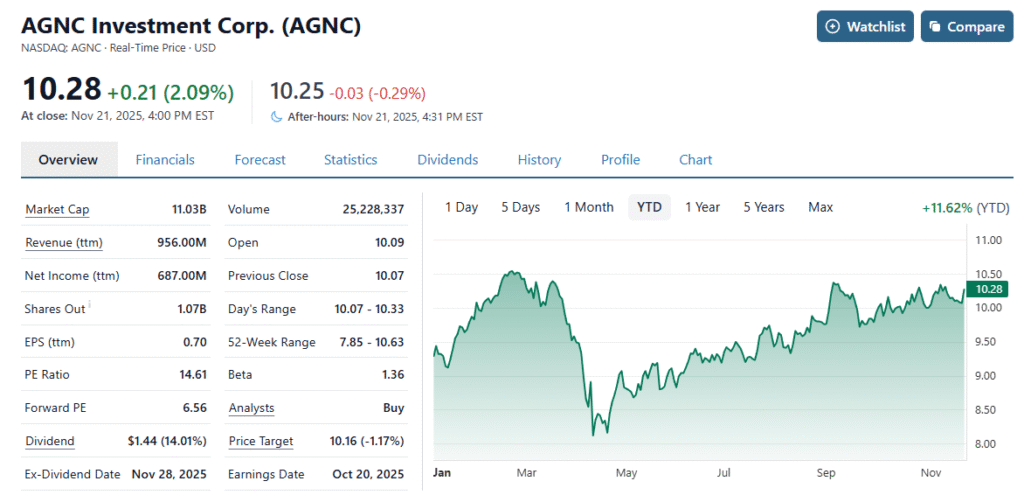
| Metric | Value |
|---|---|
| Market Cap | $11.03 Billion |
| Revenue (ttm) | $956.0 Million |
| Net Income (ttm) | $687.0 Million |
| PE Ratio | 14.61 |
| Forward PE | 6.56 |
| Dividend | $1.44 annually (14.01% yield) |
Beyond the yield
- Yield, by itself, never tells the entire tale. AGNC’s 14% yield might be alluring, but it carries compromises. Its dividend has been a slow glacial slide downhill since 2013, and payouts are flat in 2024, with no growth in sight. This decline is a risk signal, with the elevated yield illustrating weakness in the business, not strength.
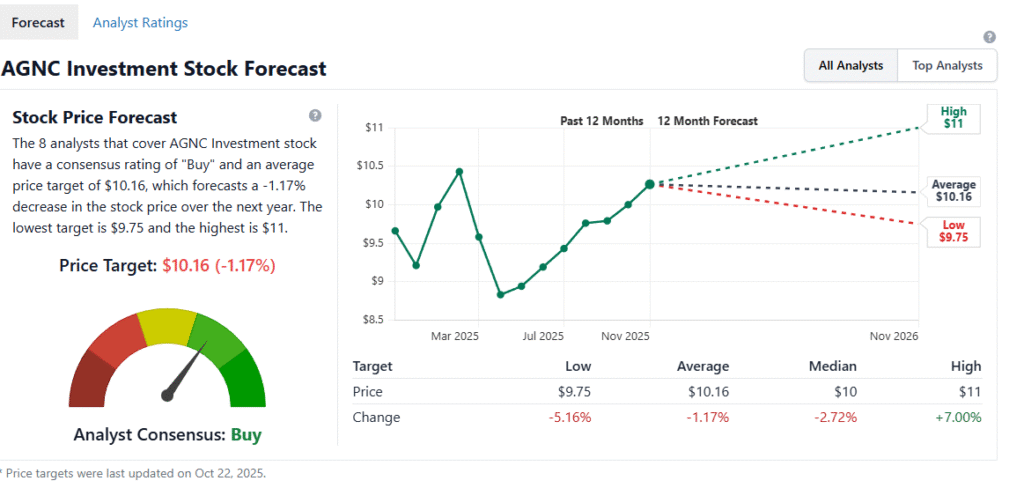
- Capital appreciation is an underappreciated component. AGNC’s stock price has been trending down, with no indication of sustainable price appreciation. For income-only investors, this can chip away at total return over time.
- The company’s diversified portfolio of mortgage-backed securities can cushion volatility. AGNC seeks to hedge risk by maintaining a portfolio of agency-backed assets, yet the specters of interest rate volatility and economic fluctuations still hover ominously.
- For AGNC, in times of market stress, the emphasis on agency securities has proven to be a stabilizing factor. Volatile rate moves can strain its income stream and asset values.
A portfolio tool
AGNC can be an income component of a broader, well-diversified portfolio, especially for investors interested in preferred stock. It tends to perform out of sync with equities or bonds, allowing it to diversify risk across asset classes and serve as a buffer during some market declines. By way of monthly income, AGNC remains appealing for cash flow collectors, even if the dividend isn’t. Others pair AGNC with less volatile, growth-oriented assets to offset the risk, treating it as a tactical allocation rather than a core position.
Long-term perspective
Time horizon is important for investors. AGNC’s model focuses on persistent income rather than growth, particularly through its agency MBS assets. The company’s pivot from less-desirable South American operations towards North America suggests a better focus on the real estate markets. However, its troubling record of falling dividends and no increases since 2013 raises concerns. AGNC has proven it can weather some economic changes, but rising rates and shifting mortgage markets are testing its mettle.
Is agnc stock a fit for you
AGNC Investment Corporation stock is an agency mortgage-backed securities-focused REIT that pays out high dividends, attracting a lot of income-focused investors. As with any investment, it requires careful consideration of how it fits with your personal financial strategy, risk tolerance, and portfolio goals. It’s essential to evaluate how AGNC investment aligns with your objectives, especially if you are an investor seeking consistent income rather than hyper growth.
Begin by considering what your personal objective is for your capital. AGNC tends to be a better fit for investors seeking income, not hyper growth. If your agenda is wealth growth over decades or you gravitate towards stocks with more price appreciation, AGNC may not be as good a match. Its biggest appeal lies in its consistent dividends, not huge increases in share value. For instance, a person nearing retirement who requires income each month might find AGNC more useful than a young worker who has the time to weather volatility in the agency MBS market.
Risk is another factor to consider when investing in AGNC. The firm invests in mortgage-backed securities, and as such, it handles fast-changing rates that can cause its price and dividend to swing. When central banks adjust base rates, mortgage-backed securities tend to fall, impacting REIT stocks like AGNC. It’s not a stock for those who lose sleep over share price swings; if you have to sell your shares at a fixed point, price declines could damage your strategy. Someone who can hold through years of rate changes may be better suited for this type of investment.
Adding AGNC to a stock mix can bring both pros and cons. That steady payout can help even out jolts if the rest of your portfolio consists of non-dividend paying stocks. Due to its concentration in one sector, mortgage-backed securities, you are not as diversified as with some other REITs or funds. If you already have a lot of real estate or lending related stocks, AGNC may simply add more of the same risk.
Before purchasing, give some serious thought to your personal finances, objectives, and risk tolerance. Just be sure to see how AGNC fits with what you already own and if it really helps you hit your long-term financial objectives.
Conclusion
AGNC Investment Corporation attracts others with its consistent distributions and transparent strategy. The stock occupies a position where income is prominent, and volatility can be significant. Some investors chase the big yield, while some stress about rates and market sentiment. AGNC’s story shows both sides: strong returns for some and sharp drops for others. Weighing risk and reward in real time, not just on paper, is essential. There is no one size fits all, so people should align AGNC to their personal objectives and constraints. To see if it fits, consider your own requirements and risk appetite. Stay up to date and consider your options carefully. If you’re still undecided, find some additional opinions and stay educated before you act.
Frequently Asked Questions
What does AGNC Investment Corporation do?
AGNC Investment Corporation primarily invests in residential mortgage-backed securities, which are supported by houses in the United States. The firm invests and makes profit from the interest payments on these loans.
Why is AGNC stock popular among dividend investors?
AGNC stock pays high dividend yields, appealing to income-seeking investors in the real estate markets, though high yields can indicate higher risk.
What are the main risks of investing in AGNC stock?
AGNC risks include interest rate risk and mortgage default risk, particularly affecting its agency MBS assets. When interest rates increase, the value of its preferred stock investments may decline, impacting both the stock price and dividends.
How does AGNC generate its dividends?
AGNC makes money on the interest payments of its agency MBS assets, paying out most of its earnings as dividends to stockholders, in accordance with REIT regulations.
Is AGNC’s dividend sustainable?
AGNC’s dividend is influenced by its earnings and interest payments. If the company’s earnings decline, it may reduce its dividend. If you’re an investor, consult the firm’s financial reporting for any updates on preferred stock.
How can I assess AGNC’s financial health?
Look at AGNC’s quarterly and annual statements, focusing on earnings and book value, as a strong balance sheet can lead to more dividend support and preferred stock stability.
Is AGNC stock suitable for long-term investors?
AGNC can fit those looking for income and who understand the risks associated with preferred stock investments. Its stock may experience large price movements with the market, so long-term investors should evaluate their financial objectives and risk tolerance.