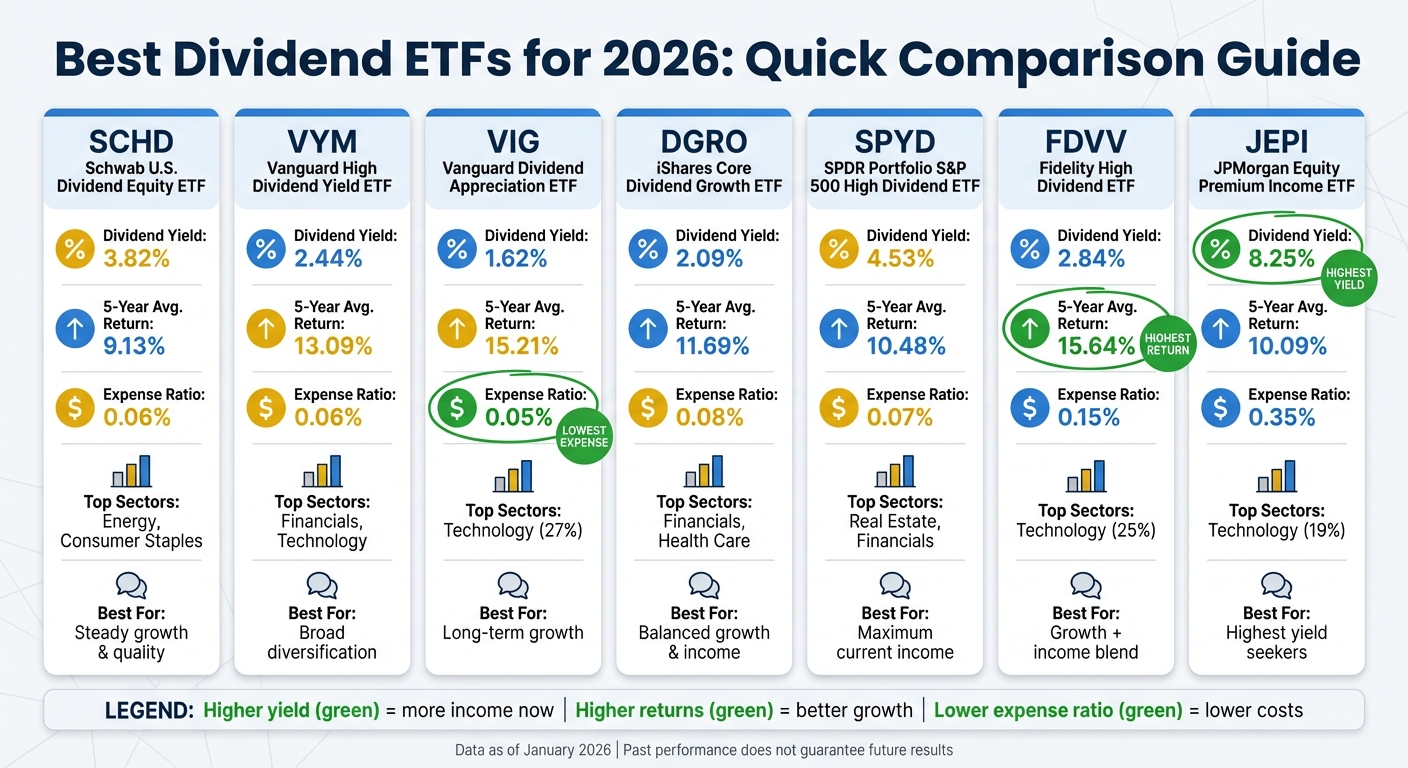


Covered call ETFs generate exceptionally high income by systematically selling call options against stock holdings, creating monthly and weekly cash flows for income investors.
These options-based ETFs employ covered call strategies to enhance yields far beyond traditional dividend stocks, with yields ranging from 8.67% to over 278%. By collecting option premiums alongside stock dividends, covered call funds provide substantial current income.
This comprehensive guide analyzes the 10 best covered call ETFs ranked by dividend yield, explaining how covered call strategies work, their risks and benefits, and which funds suit different investment objectives.
Key Takeaways
- Covered call ETFs generate exceptionally high yields ranging from 8.67% to over 278% through systematic option writing strategies that collect premiums on top of stock dividends
- Monthly and weekly payment frequencies provide regular cash flows with most funds distributing monthly while some like MSTY, NVDY, ULTY, and TSLY pay weekly for maximum income frequency
- Options income supplements stock returns as funds sell call options against holdings, collecting premiums that are distributed to shareholders as dividend income
- Yields sacrifice upside potential because sold call options cap maximum gains when underlying stocks rally strongly, creating a tradeoff between current income and capital appreciation
- Distribution sustainability varies widely with some funds maintaining consistent payouts while others experience extreme volatility based on option market conditions and stock price movements
- Underlying holdings drive performance as covered call funds typically focus on specific stocks or sectors, with exposure ranging from mega-cap tech to diversified indexes
- Tax treatment differs from qualified dividends as option income is generally taxed as short-term capital gains at ordinary income rates rather than preferential dividend rates
- Volatility impacts option premiums with higher market volatility increasing call option values and the income funds can generate, making these strategies more profitable in turbulent markets
- Not suitable for all investors as covered call strategies work best for income seekers willing to sacrifice growth potential, while growth investors should avoid these income-focused funds
Understanding Covered Call ETFs: Essential Definitions
Before analyzing specific covered call ETFs, understanding key options and strategy concepts helps investors evaluate these income-generating funds.
What is a Covered Call?
A covered call is an options strategy where investors own stock and simultaneously sell call options on those shares.
The “covered” aspect means the investor owns the underlying stock, providing shares to deliver if the buyer exercises the call option. This differs from “naked” calls where the seller doesn’t own shares.
Selling call options generates immediate premium income. In exchange, the seller gives the buyer the right to purchase shares at a predetermined strike price before expiration. If the stock price rises above the strike price, the shares may be called away at that price.
What is a Call Option?
A call option is a financial contract giving the buyer the right, but not the obligation, to purchase a stock at a specific price (strike price) before a specific date (expiration).
Call buyers pay premiums to call sellers for this right. The buyer profits if the stock price exceeds the strike price plus premium paid. The seller keeps the premium but must sell shares at the strike price if the buyer exercises.
Options trade on exchanges with standardized terms. Each contract typically represents 100 shares of the underlying stock. Options expire on specific dates, ranging from weekly to monthly to annual expirations.
What is Option Premium?
Option premium is the price paid by the option buyer to the option seller for the rights conveyed by the contract.
Premiums reflect time value (duration until expiration) and intrinsic value (difference between stock price and strike price for in-the-money options). Volatile stocks command higher premiums due to greater profit potential.
Covered call ETFs collect these premiums by systematically selling options against their stock holdings. The funds distribute collected premiums to shareholders as dividend income, creating high current yields.
What is a Strike Price?
The strike price is the predetermined price at which the option buyer can purchase (call) or sell (put) the underlying stock.
For covered calls, the strike price represents the maximum price the fund will receive if shares are called away. Choosing strike prices involves tradeoffs between premium income and upside participation.
Out-of-the-money strikes (above current stock price) generate lower premiums but allow more upside participation. At-the-money strikes (near current price) generate higher premiums but cap gains immediately.
What is Option Expiration?
Option expiration is the date when an option contract becomes void and the option buyer must decide whether to exercise their right.
Most options expire worthless as the underlying stock doesn’t move enough to make exercise profitable. When options expire worthless, the covered call seller keeps the full premium without delivering shares.
Covered call ETFs typically sell short-term options (weekly to monthly) to capture time decay. As expiration approaches, options lose value rapidly, benefiting option sellers through premium retention.
What is a Dividend Yield?
Dividend yield measures annual income as a percentage of the current investment value.
For covered call ETFs, dividend yield includes both stock dividends from underlying holdings and option premiums from sold calls. This combined income creates yields far exceeding traditional dividend stocks.
Covered call ETF yields fluctuate based on option market conditions, stock price volatility, and fund strategy. Yields aren’t guaranteed and can vary significantly month to month.
What Does “Writing Options” Mean?
Writing options means selling options contracts, creating obligations for the seller.
Option writers collect premiums immediately but assume obligations. Call writers must sell shares at the strike price if exercised. Put writers must buy shares at the strike price if exercised.
Covered call ETFs are systematic option writers, continuously selling calls against portfolio holdings. This disciplined approach generates consistent premium income for distribution to shareholders.
Complete Covered Call ETFs Ranked by Dividend Yield
Below is the complete ranking of 10 covered call ETFs by dividend yield from highest to lowest.
| Rank | Symbol | Fund Name | Div. Yield | Div. ($) | Payout Freq |
| 1 | MSTY | YieldMax MSTR Option Income Strategy ETF | 278.79% | $20.23 | Weekly |
| 2 | ULTY | YieldMax Ultra Option Income Strategy ETF | 146.01% | $58.38 | Weekly |
| 3 | TSLY | YieldMax TSLA Option Income Strategy ETF | 100.64% | $39.19 | Weekly |
| 4 | NVDY | YieldMax NVDA Option Income Strategy ETF | 80.49% | $11.76 | Weekly |
| 5 | TLTW | T. Rowe Price Dividend Growth ETF | 16.29% | $3.77 | Weekly |
| 6 | XYLD | Global X S&P 500 Covered Call ETF | 12.72% | $5.14 | Monthly |
| 7 | QYLD | Global X NASDAQ-100 Covered Call ETF | 12.57% | $2.20 | Monthly |
| 8 | RYLD | Global X Russell 2000 Covered Call ETF | 12.05% | $1.85 | Monthly |
| 9 | JEPQ | JPMorgan Equity Premium Income ETF | 10.26% | $6.00 | Monthly |
| 10 | FTHI | First Trust BuyWrite Income ETF | 8.67% | $2.05 | Monthly |
Note: Dividend yields and payments are current as of November 2025 and subject to significant variation. Past yields do not guarantee future distributions.
Best Covered Call ETFs: Detailed Analysis
Below you’ll find comprehensive analysis of the 10 best covered call ETFs ranked by dividend yield.
Best Covered Call ETF #1: YieldMax MSTR Option Income Strategy ETF (MSTY)
Dividend Yield: 278.79%
Annual Dividend: $20.23
Payout Frequency: Weekly
Underlying Focus: MicroStrategy (MSTR)
The YieldMax MSTR Option Income Strategy ETF delivers the highest yield among all covered call funds through aggressive options strategies on MicroStrategy stock.
MSTY focuses exclusively on MicroStrategy, the business intelligence company that has transformed into a leveraged Bitcoin investment vehicle. The fund’s extreme yield reflects the exceptional volatility of MSTR stock.
MicroStrategy’s stock experiences massive price swings driven by Bitcoin price movements. This volatility generates enormous option premiums that MSTY captures through weekly covered call writing.
The 278.79% annual yield is extraordinary but comes with extreme risks. Distributions fluctuate wildly week to week based on MSTR’s volatile price action and option market conditions. Investors should expect dramatic yield variations.
Strategy Details:
- Weekly covered call writing on MSTR exposure
- Captures premiums from MSTR’s extreme volatility
- Distributes option income plus any stock gains weekly
- Synthetic covered call structure using options
Investment Considerations: MSTY suits only aggressive investors comfortable with extreme volatility and distribution variability. The fund essentially provides leveraged Bitcoin exposure through MicroStrategy with enhanced income.
Weekly distributions create frequent cash flows but vary dramatically. Some weeks may pay substantial amounts while others deliver minimal income based on market conditions.
The ultra-high yield attracts income seekers but shouldn’t be confused with sustainable dividend income. MSTY operates more like a trading strategy than traditional dividend investing.
Best Covered Call ETF #2: YieldMax Ultra Option Income Strategy ETF (ULTY)
Dividend Yield: 146.01%
Annual Dividend: $58.38
Payout Frequency: Weekly
Underlying Focus: Ultra-volatile single stocks
The YieldMax Ultra Option Income Strategy ETF targets exceptionally high yields through covered calls on the most volatile individual stocks.
ULTY rotates among ultra-volatile stocks including high-flying technology companies, meme stocks, and other securities experiencing extreme price movements. The fund seeks maximum option premium income.
The 146.01% yield reflects ULTY’s focus on volatility extraction. Higher volatility creates more valuable options, generating larger premiums for the fund to distribute.
Weekly distributions provide frequent income but exhibit substantial volatility. Investors should expect dramatic swings in weekly payment amounts based on underlying stock movements and option market conditions.
Strategy Characteristics:
- Focuses on highest volatility single stocks
- Weekly options writing for maximum premium capture
- Rotates holdings to target volatility opportunities
- Extremely high but variable distributions
Risk Factors: ULTY carries exceptional risk from concentrated single-stock exposure and extreme volatility. The fund can experience dramatic drawdowns when targeted stocks collapse.
The strategy sacrifices virtually all upside participation beyond strike prices. During strong bull markets, ULTY will underperform significantly as gains are capped.
Only sophisticated investors understanding options strategies and comfortable with extreme volatility should consider ULTY. The fund operates more as a speculative income vehicle than conservative investment.
Best Covered Call ETF #3: YieldMax TSLA Option Income Strategy ETF (TSLY)
Dividend Yield: 100.64%
Annual Dividend: $39.19
Payout Frequency: Weekly
Underlying Focus: Tesla (TSLA)
The YieldMax TSLA Option Income Strategy ETF generates exceptional income through covered calls on Tesla stock exposure.
TSLY concentrates entirely on Tesla, capturing the option premiums generated by TSLA’s legendary volatility. Tesla stock experiences dramatic price swings driven by company news, Elon Musk tweets, and broader market sentiment.
The 100.64% yield demonstrates the enormous option income available from Tesla’s volatility. Few stocks generate larger option premiums relative to share prices than Tesla.
Weekly distributions create frequent cash flows for income investors. However, payment amounts fluctuate significantly based on Tesla’s price movements and volatility levels.
Investment Profile:
- Pure Tesla exposure with covered call overlay
- Weekly option writing capturing TSLA volatility
- Distributions from option premiums plus any capped gains
- Synthetic exposure using options strategies
Suitability Assessment: TSLY suits Tesla bulls seeking income rather than maximum capital appreciation. The fund allows Tesla exposure while generating substantial current income.
Investors sacrifice unlimited Tesla upside in exchange for high current yield. During periods when Tesla rallies sharply, TSLY will underperform owning TSLA directly.
The concentrated single-stock risk makes TSLY unsuitable for conservative investors. Position sizing should reflect the extreme volatility and distribution variability.
Best Covered Call ETF #4: YieldMax NVDA Option Income Strategy ETF (NVDY)
Dividend Yield: 80.49%
Annual Dividend: $11.76
Payout Frequency: Weekly
Underlying Focus: NVIDIA (NVDA)
The YieldMax NVDA Option Income Strategy ETF provides covered call income from NVIDIA stock exposure.
NVDY focuses on NVIDIA, the artificial intelligence chip leader experiencing enormous growth and corresponding stock volatility. The fund captures option premiums from NVDA’s large price movements.
The 80.49% yield reflects NVIDIA’s substantial volatility and the valuable option premiums this creates. As AI enthusiasm drives NVDA price swings, option writers collect significant premiums.
Weekly distributions provide regular income streams. Payment amounts vary based on NVIDIA’s stock performance and option market dynamics but generally remain substantial.
Fund Strategy:
- NVIDIA exposure with systematic covered call overlay
- Weekly options for maximum premium capture frequency
- Distributes option income plus limited stock appreciation
- Options-based synthetic exposure structure
Investment Perspective: NVDY appeals to investors bullish on NVIDIA’s long-term prospects but seeking current income over maximum growth. The fund provides AI exposure with substantial yield.
The covered call overlay caps upside during NVIDIA rallies. Given NVDA’s powerful growth trajectory, this tradeoff may sacrifice significant gains for current income.
Concentrated single-stock exposure creates meaningful risk. NVDY should represent only a portion of diversified portfolios given NVIDIA-specific risks.
Best Covered Call ETF #5: T. Rowe Price Dividend Growth ETF (TLTW)
Dividend Yield: 16.29%
Annual Dividend: $3.77
Payout Frequency: Monthly
Underlying Focus: Diversified dividend growth stocks
The T. Rowe Price Dividend Growth ETF combines dividend growth stock selection with covered call writing for enhanced income.
TLTW differs from single-stock YieldMax funds by holding diversified portfolios of dividend growth companies. The fund writes covered calls against these holdings to supplement dividend income with option premiums.
The 16.29% yield significantly exceeds typical dividend growth fund yields of 2-3%. This yield enhancement comes from systematic covered call writing across portfolio holdings.
Monthly distributions provide predictable cash flows. The diversified approach creates more stable distributions than single-stock covered call funds, though still variable based on market conditions.
Differentiated Approach:
- Diversified dividend growth stock portfolio
- Covered calls written across multiple holdings
- Combines dividend income with option premiums
- More conservative than single-stock strategies
Comparative Advantages: TLTW offers substantially lower risk than concentrated single-stock funds. Portfolio diversification reduces impact of any single stock’s poor performance.
The dividend growth focus provides some underlying appreciation potential alongside high current yield. This balanced approach suits investors seeking both income and modest growth.
Monthly rather than weekly distributions may appeal to investors preferring less frequent but more predictable income streams.
Best Covered Call ETF #6: Global X S&P 500 Covered Call ETF (XYLD)
Dividend Yield: 12.72%
Annual Dividend: $5.14
Payout Frequency: Monthly
Underlying Focus: S&P 500 Index
The Global X S&P 500 Covered Call ETF writes covered calls against S&P 500 holdings for enhanced income.
XYLD holds an S&P 500 portfolio and systematically sells at-the-money call options on the index. This strategy captures substantial premium income while maintaining broad market exposure.
The 12.72% yield dramatically exceeds the S&P 500’s natural dividend yield of approximately 1.5%. This yield enhancement comes entirely from option premium income.
Monthly distributions provide regular income. XYLD maintains relatively consistent payments compared to single-stock covered call funds, though distributions still fluctuate with market volatility.
Index-Based Strategy:
- Full S&P 500 replication
- At-the-money covered calls on SPX index
- Monthly option expirations
- Captures time decay and volatility premiums
Risk-Return Profile: XYLD trades S&P 500 upside participation for high current income. During strong bull markets, the fund significantly underperforms SPY as gains are capped at strike prices.
The broad diversification provides stability compared to single-stock funds. Five hundred stock holdings eliminate single-company risk.
XYLD suits income-focused investors willing to sacrifice growth for current yield. The fund works well for retirees needing cash flow from portfolios.
Best Covered Call ETF #7: Global X NASDAQ-100 Covered Call ETF (QYLD)
Dividend Yield: 12.57%
Annual Dividend: $2.20
Payout Frequency: Monthly
Underlying Focus: NASDAQ-100 Index
The Global X NASDAQ-100 Covered Call ETF applies covered call strategies to NASDAQ-100 technology holdings.
QYLD holds NASDAQ-100 stocks and writes at-the-money covered calls on the index. The fund captures premium income from technology stock volatility while maintaining diversified tech exposure.
The 12.57% yield far exceeds NASDAQ-100’s natural yield below 1%. Technology stocks pay minimal dividends, making option income particularly valuable for income investors.
Monthly distributions provide consistent cash flows. QYLD’s payments vary less than single-stock funds due to broad diversification across 100 technology and growth companies.
Technology Focus:
- NASDAQ-100 constituent holdings
- Covered calls on QQQ equivalent exposure
- Benefits from technology sector volatility
- Monthly option writing cycle
Strategic Considerations: QYLD suits investors wanting technology exposure with substantial current income. The fund provides access to major tech companies while generating high yield.
Technology stocks typically deliver returns through appreciation rather than dividends. QYLD converts potential appreciation into current income through option premiums.
The covered call overlay significantly limits upside during technology rallies. Given tech’s strong long-term growth, this tradeoff may sacrifice substantial gains.
Best Covered Call ETF #8: Global X Russell 2000 Covered Call ETF (RYLD)
Dividend Yield: 12.05%
Annual Dividend: $1.85
Payout Frequency: Monthly
Underlying Focus: Russell 2000 Index
The Global X Russell 2000 Covered Call ETF writes covered calls against small-cap stock holdings.
RYLD holds Russell 2000 small-cap stocks and systematically sells covered calls on the index. The fund captures premium income from small-cap volatility.
The 12.05% yield significantly exceeds Russell 2000’s natural dividend yield of approximately 1.5%. Small-cap volatility generates attractive option premiums for income distribution.
Monthly distributions provide regular income. Small-cap volatility creates larger premium opportunities but also more variable distributions than large-cap equivalents.
Small-Cap Exposure:
- Russell 2000 Index replication
- Covered calls on small-cap index
- Higher volatility than large-cap alternatives
- Monthly option expirations
Unique Characteristics: RYLD provides small-cap exposure with substantial income generation. The fund suits investors seeking small-cap diversification with high yield.
Small-cap stocks historically outperform large-caps over long periods. RYLD sacrifices this outperformance potential for current income through covered call overlay.
Higher small-cap volatility increases both option income and principal volatility. RYLD experiences larger price swings than large-cap covered call alternatives.
Best Covered Call ETF #9: JPMorgan Equity Premium Income ETF (JEPQ)
Dividend Yield: 10.26%
Annual Dividend: $6.00
Payout Frequency: Monthly
Underlying Focus: Large-cap U.S. equities
The JPMorgan Equity Premium Income ETF combines active equity selection with systematic covered call writing.
JEPQ holds an actively managed portfolio of large-cap stocks selected by JPMorgan’s research team. The fund writes covered calls against these holdings to enhance income beyond dividends.
The 10.26% yield reflects both option premium income and JPMorgan’s active management approach. The fund targets lower volatility stocks that may preserve more capital during downturns.
Monthly distributions provide consistent income. JEPQ’s actively managed approach aims for more stable distributions than pure index-based covered call strategies.
Active Management:
- JPMorgan stock selection expertise
- Emphasis on lower volatility equities
- Covered calls written against active portfolio
- Risk management overlay
Management Advantage: JEPQ’s active management differentiates it from passive index covered call funds. JPMorgan’s team can adjust holdings based on market conditions.
The lower volatility focus may reduce option income but also limits drawdowns during market declines. This defensive approach suits conservative income investors.
JPMorgan’s brand and expertise add credibility. The fund benefits from institutional-quality research and risk management.
Best Covered Call ETF #10: First Trust BuyWrite Income ETF (FTHI)
Dividend Yield: 8.67%
Annual Dividend: $2.05
Payout Frequency: Monthly
Underlying Focus: Diversified large-cap stocks
The First Trust BuyWrite Income ETF employs covered call strategies on diversified large-cap holdings.
FTHI maintains a diversified portfolio of large-cap stocks and writes covered calls to generate premium income. The fund targets consistent income with lower volatility than aggressive covered call strategies.
The 8.67% yield is the lowest among covered call ETFs analyzed but still significantly exceeds traditional dividend yields. This moderate yield reflects a more conservative option writing approach.
Monthly distributions provide reliable income. FTHI’s conservative strategy creates relatively stable distributions compared to aggressive single-stock alternatives.
Conservative Approach:
- Diversified large-cap portfolio
- Selective covered call writing
- Focus on income consistency over maximum yield
- Risk-managed implementation
Positioning: FTHI suits conservative investors seeking enhanced income without extreme volatility. The fund balances yield enhancement with capital preservation.
The lower yield allows more upside participation than at-the-money strategies. FTHI may capture more appreciation during bull markets.
This conservative positioning appeals to risk-averse income investors who find ultra-high yields concerning. FTHI demonstrates covered calls can enhance income moderately without excessive risk.
How Covered Call Strategies Work: Detailed Explanation
Understanding covered call mechanics helps investors evaluate whether these strategies suit their objectives.
Basic Covered Call Mechanics
Covered call sellers own 100 shares of stock per option contract sold. This stock ownership “covers” the obligation to deliver shares if the option is exercised.
The seller collects premium immediately upon selling the call option. This premium provides income regardless of whether the option is exercised.
If the stock price remains below the strike price at expiration, the option expires worthless. The seller keeps the premium and still owns the shares, allowing another call to be written.
If the stock price rises above the strike price, the buyer may exercise, forcing the seller to deliver shares at the strike price. The seller keeps the premium but caps gains at the strike price.
Monthly vs. Weekly Options
Covered call ETFs choose different option expiration frequencies based on strategy objectives.
Monthly options provide larger premiums per contract due to more time value. However, monthly expirations mean only 12 income opportunities per year.
Weekly options generate smaller per-contract premiums but create 52 annual income opportunities. This frequency allows funds to capture time decay more rapidly.
Weekly strategies work well in volatile markets where prices fluctuate significantly. Monthly strategies may suit more stable underlying securities.
Strike Price Selection Impact
Strike price selection dramatically impacts covered call outcomes and risk-return profiles.
At-the-money strikes (near current stock price) generate maximum premium income but cap gains immediately. Any stock appreciation above the strike is sacrificed.
Out-of-the-money strikes (above current price) generate lower premiums but allow some upside participation. The stock can rise to the strike price before gains are capped.
In-the-money strikes (below current price) generate very high premiums but almost guarantee assignment. These aggressive strategies prioritize income over growth.
Volatility’s Impact on Option Premiums
Stock volatility directly affects option premium values and covered call income potential.
Higher volatility increases option premiums as larger price movements create more profit potential for option buyers. Volatile stocks generate more income for covered call sellers.
During market turbulence, implied volatility rises, increasing option premiums across all stocks. Covered call funds generate more income during volatile periods.
Conversely, low volatility periods reduce option premiums and fund distributions. The VIX index measures market volatility and correlates with covered call fund income.
Rolling Options
Covered call ETFs often “roll” options rather than accepting assignment when calls go in-the-money.
Rolling involves buying back the sold call option and simultaneously selling a new call with a later expiration or higher strike price. This maintains stock ownership while collecting additional premium.
Successful rolling allows funds to continue holding appreciated stocks rather than having them called away. However, rolling costs money (buying back the option) and may reduce income.
Rolling decisions require active management and experience. Automated rolling strategies may underperform discretionary approaches during unusual market conditions.
Covered Call ETFs vs. Traditional Dividend Stocks
Understanding key differences between covered call funds and traditional dividend investments helps optimize portfolio allocation.
Income Levels
Covered call ETFs generate substantially higher yields than traditional dividend stocks, often 3-10x higher.
Traditional dividend stocks typically yield 2-4% with Dividend Aristocrats averaging around 3%. Covered call funds yield 8-15% for conservative strategies and 50-200%+ for aggressive single-stock approaches.
This dramatic yield difference comes from option premium income supplementing stock dividends. However, higher yields don’t necessarily mean better total returns.
Income Stability
Traditional dividend stocks provide more stable, predictable income than covered call funds.
Established dividend payers increase distributions annually with minimal cuts. Companies like Johnson & Johnson and Coca-Cola have increased dividends for 50+ consecutive years.
Covered call fund distributions fluctuate based on market volatility, stock price movements, and option market conditions. Monthly payments can vary 30-50% or more.
Total Return Potential
Traditional dividend stocks offer higher total return potential through both dividends and appreciation.
Quality dividend stocks grow earnings and dividends over time while stock prices appreciate. Total returns average 8-10% annually including both income and growth.
Covered call funds sacrifice appreciation for current income. Total returns typically trail traditional dividend stocks over full market cycles, particularly during strong bull markets.
Tax Efficiency
Traditional qualified dividend stocks receive preferential tax treatment while covered call option income faces higher taxes.
Qualified dividends are taxed at 0%, 15%, or 20% depending on income level. This favorable treatment significantly improves after-tax returns.
Option premium income is generally taxed as short-term capital gains at ordinary income rates up to 37%. This tax disadvantage reduces after-tax yields substantially for high-income investors.
Capital Appreciation
Traditional dividend stocks provide full upside participation while covered calls cap gains.
Dividend stock investors benefit from all appreciation as stock prices rise. During bull markets, capital gains can exceed dividend income significantly.
Covered call strategies limit gains to strike prices. During rallies, call options get exercised and shares are called away at capped prices, missing further appreciation.
Tax Implications of Covered Call ETFs
Covered call ETF taxation differs significantly from traditional dividend stocks, affecting after-tax returns.
Option Premium Taxation
Option premiums collected by covered call ETFs are generally treated as short-term capital gains.
These gains are taxed at ordinary income tax rates ranging from 10% to 37% depending on total taxable income. This treatment is much less favorable than qualified dividend rates of 0-20%.
For investors in the highest tax brackets, ordinary income treatment can reduce after-tax yields by 30-40% compared to pre-tax yields. This dramatically impacts total returns.
Return of Capital Distributions
Some covered call ETF distributions include return of capital components.
Return of capital isn’t immediately taxable but reduces cost basis in the investment. Lower cost basis means higher capital gains when shares are eventually sold.
Investors should review 1099-DIV forms carefully to understand distribution composition. Return of capital affects long-term tax planning and basis tracking.
Tax-Advantaged Account Benefits
Holding covered call ETFs in IRAs or other tax-deferred accounts eliminates current taxation on distributions.
Traditional IRAs defer all taxes until withdrawal, when ordinary rates apply regardless of distribution type. This eliminates the covered call tax disadvantage.
Roth IRAs provide tax-free distributions after five years and age 59½. This makes Roth accounts ideal for covered call strategies, converting ordinary income into tax-free withdrawals.
Wash Sale Considerations
Frequent option trading in covered call strategies can create wash sale complications.
Wash sales occur when substantially identical securities are purchased within 30 days before or after selling at a loss. This disallows the tax loss.
Covered call ETFs buying and selling options frequently can trigger wash sale rules. However, this primarily affects the funds internally rather than shareholders directly.
Building Portfolios with Covered Call ETFs
Investors can incorporate covered call funds strategically based on income needs and risk tolerance.
Conservative Income Portfolio
Risk-averse income investors might allocate 20-30% to conservative covered call funds like JEPQ, XYLD, or FTHI alongside traditional dividend stocks.
This allocation enhances portfolio yield from 3% to 4-5% while maintaining significant traditional dividend exposure. The modest covered call allocation provides income boost without excessive risk.
Conservative covered call funds with diversified holdings and moderate yields reduce concentration and distribution volatility risks.
Aggressive Income Portfolio
Income-focused investors comfortable with volatility could allocate 50-70% to covered call strategies including QYLD, XYLD, and select single-stock funds.
This aggressive allocation can generate portfolio yields of 10-15% or higher. However, investors sacrifice substantial growth potential and accept high distribution variability.
Diversifying across multiple covered call strategies reduces concentration risk while maintaining elevated yields.
Speculation Allocation
Risk-tolerant investors might dedicate 5-15% of portfolios to ultra-high-yield single-stock funds like MSTY, TSLY, or NVDY.
This small speculative allocation provides lottery-ticket upside from extreme yields without risking portfolio stability. Position sizing acknowledges high risk of permanent capital loss.
Speculative allocations should use only risk capital that can be lost without impacting financial security.
Tactical Income Enhancement
During high volatility periods, temporarily increasing covered call allocations capitalizes on elevated option premiums.
When VIX spikes above 25-30, option premiums surge, increasing covered call income potential. Tactical shifts into covered call strategies during volatility can boost portfolio income.
This active approach requires monitoring market conditions and willingness to adjust allocations based on volatility cycles.
Risks to Consider with Covered Call ETFs
While covered call ETFs offer high income, investors must understand significant risks before allocating capital.
Limited Upside Participation
Covered call strategies cap gains at strike prices, missing rallies beyond those levels.
During powerful bull markets like 2023’s tech surge, covered call funds dramatically underperformed. XYLD returned approximately 4% while SPY gained 26%.
This opportunity cost of missed appreciation can exceed income received. Over full market cycles, covered calls often underperform buy-and-hold strategies.
Distribution Volatility
Covered call fund distributions fluctuate significantly based on market conditions.
Monthly payments can vary 30-100% between periods of high and low volatility. Investors expecting consistent income face disappointment during stable markets.
Single-stock funds experience extreme distribution volatility. Weekly payments can range from pennies to dollars based on underlying stock movements.
Concentration Risk
Single-stock covered call funds carry enormous concentration risk from depending on one company’s performance.
If the underlying stock collapses, the fund experiences devastating losses. Option income doesn’t offset major principal declines.
Funds like MSTY and TSLY could lose 50-80% if MicroStrategy or Tesla crashed. The high yields don’t justify this concentration risk for most portfolios.
Tax Inefficiency
Ordinary income tax treatment of option premiums creates significant tax drag.
High-income investors in 37% tax brackets see after-tax yields reduced by over one-third. A 12% pre-tax yield becomes 7.5% after tax.
This tax inefficiency makes covered call funds poor choices for taxable accounts for high-income investors. Tax-deferred accounts significantly improve after-tax outcomes.
Complexity and Costs
Covered call strategies involve complexity and costs that may reduce investor returns.
Option trading requires expertise in options markets, strike selection, and rolling strategies. Poor execution can destroy returns.
Management fees for covered call ETFs range from 0.35% to 0.99%, higher than traditional index funds. These costs compound over time, reducing long-term wealth accumulation.
Conclusion
Covered call ETFs provide investors with high-income opportunities through systematic option writing strategies that generate premium income alongside stock dividends.
The 10 best covered call ETFs ranked by yield range from 8.67% to over 278%, offering income opportunities unavailable through traditional dividend stocks. Monthly and weekly distributions create frequent cash flows for income-focused investors.
Conservative options like JEPQ, XYLD, and FTHI provide enhanced income with moderate risk through diversified holdings and disciplined option writing. These funds suit income investors willing to sacrifice some growth for current yield.
Aggressive single-stock funds like MSTY, TSLY, and NVDY offer extreme yields but carry substantial risks including concentration, volatility, and potential permanent capital loss. Only risk-tolerant speculators should allocate to these strategies.
Understanding covered call mechanics, tax implications, and risk-return tradeoffs helps investors select appropriate funds based on individual objectives. Combining conservative covered call strategies with traditional dividend stocks creates balanced income portfolios.
Disclaimer: This article is for informational purposes only and should not be considered investment advice. Options strategies carry substantial risks including potential total loss of investment. Distribution yields are not guaranteed and fluctuate significantly. Always conduct your own research and consult with a financial advisor before making investment decisions.