

Introduction
If you’re exploring options trading for beginners, this guide will show you exactly what’s possible—and what’s realistic. Picture this: You invest $105 in a single options trade and walk away with $5,550. That’s exactly what happened when I traded UnitedHealth Group (UNH) call options, turning a small speculative bet into a 5,024% return in a matter of weeks.
Before you get too excited, let me be crystal clear: this was an exceptional outcome, not a typical result. I’ve also had options expire completely worthless, taking my entire investment with them. Options trading is powerful, leveraged, and risky.
If you’re interested in options trading for beginners, you’ve come to the right place. In this comprehensive guide, I’ll walk you through everything you need to know to get started with options trading.
You’ll learn what options are, how they work, the strategies you can use, and most importantly, how to manage risk. I’ll use my actual UNH trade (with screenshots and real numbers) to illustrate both the potential and the dangers of options trading.
At Bullishflow.com, we primarily focus on dividend investing for long-term wealth building. But options can serve as a complementary tool when used properly and with money you can afford to lose. Let’s dive in.
Key Takeaways
Before we dive deep, here are the essential points you’ll learn in this guide:
What You’ll Learn:
- Options are contracts giving you the right (not obligation) to buy or sell stocks at specific prices by specific dates
- Call options let you profit from stocks going UP; put options let you profit from stocks going DOWN
- Your maximum risk when buying options is the premium you pay – you can’t lose more than your initial investment
- Options provide leverage (control 100 shares for a fraction of the cost) but expire worthless if the stock doesn’t move in your favor
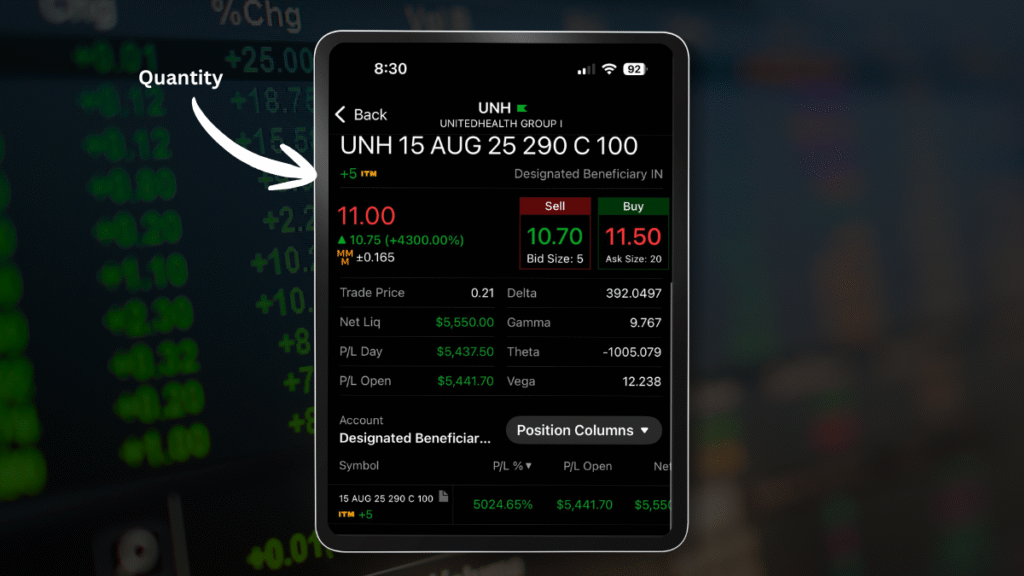
Real Trade Example:
- I turned $105 into $5,550 trading UNH call options (5,024% return)
- This was exceptional, NOT typical – I’ve also had options expire worthless
- The trade worked due to specific catalysts (Warren Buffett rumors) and oversold conditions
- Position sizing was critical – I only risked money I could afford to lose completely
Critical Warnings:
- Time decay erodes option value every single day, even if the stock doesn’t move
- Most options expire worthless – this is a high-risk, speculative strategy
- Never risk more than 1-2% of your trading capital on a single options trade
- Options trading should be done with “speculation capital,” not retirement savings
Best Practices:
- Start with paper trading (fake money) before risking real capital
- Give yourself time – buy options with 60-90+ days to expiration
- Have an exit plan BEFORE entering any trade
- Focus on liquid options with good volume and tight bid-ask spreads
- Learn the Greeks (delta, theta, gamma, vega) to understand how your options will behave
When to Use Options:
- You have specific short-term market views backed by catalysts
- You want leveraged exposure with defined risk
- You’re generating income through covered calls on stocks you own
- You understand and accept you could lose 100% of each trade
Bottom Line: Options can be profitable when used correctly, but they require education, discipline, and proper risk management. They should complement, not replace, a solid long-term investment strategy focused on stocks, bonds, and dividend-paying securities.
What Are Options?
The Basics Explained Simply
Options are financial contracts that give you the right, but not the obligation, to buy or sell a stock at a specific price (called the strike price) by a specific date (the expiration date). Think of them as insurance policies or reservations on stocks.
There are two main types of options:
Call Options: Give you the right to BUY a stock at the strike price. You buy calls when you think a stock will go UP.
Put Options: Give you the right to SELL a stock at the strike price. You buy puts when you think a stock will go DOWN.
When you buy an option, you pay a premium (the price of the contract). This premium is your maximum risk as a buyer. The option will either make you money or expire worthless, but you can never lose more than the premium you paid upfront.
Key Terms You Need to Know:
- Premium: The price you pay to buy the option contract (your maximum risk)
- Strike Price: The price at which you can buy or sell the underlying stock
- Expiration Date: The last day the option is valid
- Contract Size: Each options contract typically represents 100 shares of stock
- In-the-Money (ITM): When exercising the option would be profitable
- Out-of-the-Money (OTM): When exercising the option would not be profitable
- At-the-Money (ATM): When the strike price equals the current stock price
How Options Differ From Stocks
When you buy stock, you own a piece of the company indefinitely. The stock can go up or down, and you hold it as long as you want. You might also receive dividends.
Options are fundamentally different:
1. Leverage: Options give you control over 100 shares of stock for a fraction of what it would cost to buy those shares outright. This leverage amplifies both gains and losses.
2. Expiration: Options have expiration dates. If the stock doesn’t move in your favor by expiration, the option expires worthless and you lose your entire investment.
3. Time Decay: Options lose value every day as expiration approaches, even if the stock doesn’t move. This is called theta or time decay.
4. Limited Risk for Buyers: When you buy options, your maximum loss is the premium paid. When you buy stock, it could theoretically go to zero.
5. No Ownership: Buying an option doesn’t make you a shareholder. You don’t receive dividends or voting rights.
Real-World Example: My $5,500 UNH Options Trade
Now let’s look at a real trade I made that demonstrates both the power and the risks of options trading.
The Setup
Stock: UnitedHealth Group (UNH)
Contract Details:
- Type: Call option
- Strike Price: $290
- Expiration: August 15, 2025
- Premium Paid: Approximately $0.21 per contract
- Number of Contracts: 5 contracts
- Total Investment: $105 (5 contracts × $0.21 × 100 shares per contract)
Position at Screenshot:
- Current Option Price: $11.00 per contract
- Total Position Value: $5,550.00
- Profit/Loss: +$5,441.70
- Return: 5,024.65%
- Status: In-the-Money (ITM) +5
[Screenshot would be inserted here showing the actual trade details, Greeks, and P/L]
Why I Made This Trade
I didn’t randomly throw $105 at UNH options. I had specific reasons for entering this position, though I’ll admit it was still a speculative bet.
The Catalyst: Warren Buffett Rumors
Rumors were circulating that Warren Buffett’s Berkshire Hathaway had taken a position in UnitedHealth Group. When legendary investors like Buffett show interest in a stock, it often creates significant upward momentum as institutional and retail investors follow suit. While these rumors don’t always pan out (and sometimes are completely false), they can be powerful short-term catalysts.
The Opportunity: Stock Under Pressure
UNH had been suffering from ongoing Medicare and Medicaid investigations by federal regulators. These investigations were making headlines and putting downward pressure on the stock price. The market was pricing in regulatory risk and potential fines.
However, I believed this created an opportunity. UnitedHealth Group is the largest health insurance company in the United States, with a strong underlying business and a track record of navigating regulatory challenges. The company is also a Dividend Aristocrat, having increased its dividend for 14 consecutive years, demonstrating financial stability and shareholder commitment.
My Thesis:
- The Buffett rumor could trigger a short-term rally
- The Medicare/Medicaid investigation concerns were likely already priced into the stock
- UNH’s fundamental business remains strong despite regulatory headwinds
- Healthcare sector positioning was favorable
- Risk was limited to just $105, money I could afford to lose completely
Why These Specific Contracts:
The $290 strike price was out-of-the-money but seemed achievable if the Buffett news gained traction or if the regulatory concerns eased. The August 15, 2025 expiration date gave me several months for my thesis to play out, though it also meant significant time decay exposure.
At just $0.21 per contract, the premium was cheap enough to take a small speculative position. I knew these were essentially lottery tickets with low probability of success, but the risk-reward ratio was attractive for $105.
How the Trade Played Out
Let me break down what the screenshot reveals about this position:
The Option Pricing:
- Entry Price: $0.21 per contract
- Current Price: $11.00 per contract
- Gain Per Contract: $10.79
- Total Gain: $5,441.70
- Return: 5,024.65%
The Greeks (These Matter!):
The screenshot shows key metrics called “the Greeks” that measure different aspects of options pricing:
- Delta: 392.0497 – This means for every $1 that UNH stock moves up, my entire position increases in value by approximately $392. Delta also represents the approximate probability that the option will expire in-the-money.
- Gamma: 9.767 – This measures how much delta will change when the stock moves. Higher gamma means delta is accelerating, which amplifies gains (or losses) as the stock moves.
- Theta: -1005.079 – This is the scary one. My position was losing approximately $1,005 per day to time decay. Every day that passed without UNH moving higher, I was bleeding value at this rate.
- Vega: 12.238 – This measures sensitivity to changes in implied volatility. If market volatility increased, my position would gain value; if volatility decreased, I’d lose value.
Current Status:
The position shows “ITM +5” meaning all 5 contracts are In-The-Money. The Net Liquidation value is $5,550, and I had unrealized gains of $5,437.50 on the day shown with P/L Open at $5,441.70.
Critical Lessons From This Trade
1. This Was an Exceptional Outcome
Let me emphasize this again: a 5,024% return is NOT typical. This represents an outlier result where multiple factors aligned in my favor. Most options trades result in smaller gains, break-even results, or complete losses. I’ve had plenty of options expire worthless, taking my entire premium with them.
Don’t expect these results regularly. If I made 20 similar trades, maybe one or two would work out this well, while the majority would result in losses.
2. Catalysts Drive Options Trades
The Warren Buffett rumor was the catalyst that gave this trade momentum. Options trading is often about timing specific events: earnings announcements, FDA approvals, merger news, or in this case, famous investor activity.
Trading options around catalysts can amplify gains dramatically, but it also increases risk. If the catalyst doesn’t materialize or goes the wrong direction, options can lose value extremely quickly.
3. Buying the Dip Can Work, But It’s Risky
UNH was down due to Medicare/Medicaid investigations. I believed this was temporary negativity affecting a fundamentally strong company. This “buy the dip” mentality paid off this time.
However, this strategy could have easily backfired. If the investigations had worsened, if regulators had announced major fines, or if UNH’s earnings had disappointed, the stock could have dropped further and my options would have expired worthless.
4. Position Sizing Saved Me From Stress
Because I only risked $105, money I could afford to lose completely, I wasn’t stressed watching this trade develop. I could hold through volatility without losing sleep.
If I had invested $10,000 into this same trade, the massive negative theta (-$1,005/day) would have been terrifying. The emotional pressure would have likely caused me to exit early or make poor decisions.
This is perhaps the most important lesson: only trade options with money you can afford to lose entirely.
5. Time Decay Is Real and Brutal
Look at that theta number again: -1005.079. My position was losing over $1,000 per day to time decay. Time decay accelerates as expiration approaches, and it’s relentless.
If UNH hadn’t moved quickly and decisively in my favor, this entire position would have evaporated. Most beginners don’t understand how fast options lose value as expiration nears. You can be right about the direction but still lose money if the stock doesn’t move fast enough.
6. Deep Out-of-the-Money Options Are Lottery Tickets
At $0.21 per contract, these were essentially lottery tickets. The $290 strike price was significantly out-of-the-money when I bought them. The probability of success was low, which is why the premium was so cheap.
This is high-risk, high-reward speculation, not investing. I knew the odds were against me, but the asymmetric risk-reward ratio (risk $105 to potentially make thousands) made it an acceptable speculation.
7. Having a Thesis Matters
I didn’t randomly buy these options. I had specific reasons: Buffett rumors, oversold conditions due to regulatory concerns, and belief in UNH’s underlying strength. Even with a thesis, this was still highly speculative.
Many beginners buy options based on gut feelings, tips from social media, or simply because they want to get rich quick. Having a clear thesis and understanding why you’re making the trade is crucial.
What Could Have Gone Wrong:
Let’s be honest about all the ways this trade could have failed:
- The Buffett rumors could have been completely false (they often are)
- The Medicare/Medicaid investigations could have escalated
- Regulators could have announced major fines or penalties
- UNH could have reported disappointing earnings
- The broader healthcare sector could have sold off
- Time decay could have eroded the entire position before UNH moved
- August expiration could have arrived with UNH still below $290
- I would have lost my entire $105 investment
Any of these scenarios was more likely than the outcome that actually occurred.
The Contrast With Dividend Investing:
Here’s an important perspective: UnitedHealth Group is actually a Dividend Aristocrat with 14 consecutive years of dividend increases. If I had simply bought and held UNH stock instead of options, I would be collecting steady quarterly dividends with much less volatility.
A share of UNH costs around $500-600 (depending on market conditions). With my $105, I couldn’t even buy a single share. But I could control 500 shares (5 contracts × 100 shares) through options, which gave me massive leverage.
Options gave me the potential for explosive gains, but with explosive risk and a ticking clock. Stock ownership gives you time, dividends, and ownership in a real business. Different tools for different goals.
Understanding Call Options
Now that you’ve seen a real call option trade, let’s break down how call options work in detail.
What Are Call Options?
A call option gives you the right, but not the obligation, to buy 100 shares of a stock at a specific strike price before the expiration date. You pay a premium for this right.
Think of it like making a reservation to buy a stock at a set price. If the stock goes above your strike price, you can exercise your option and buy the stock at the lower strike price. If the stock doesn’t reach your strike price, you can let the option expire and you only lose the premium you paid.
When You’d Buy Calls:
- You believe a stock will rise significantly
- You want leveraged exposure without buying the actual stock
- You’re trading around a specific catalyst (earnings, news, etc.)
- You want defined risk (limited to the premium paid)
Call Option Example Walkthrough
Let’s use a simple example to understand the mechanics:
Scenario: Stock XYZ is currently trading at $100 per share.
You’re bullish on XYZ and believe it will rise to $110 or higher within the next 30 days.
The Trade:
- Buy a $105 call option expiring in 30 days
- Premium: $2.00 per share ($200 per contract for 100 shares)
- Your maximum risk: $200
- Your maximum profit: Unlimited (technically)
- Breakeven: $107 ($105 strike + $2 premium)
Scenario 1: Stock Goes to $110
- Your call option is now worth at least $5 ($110 current price – $105 strike)
- Your profit: $5 – $2 = $3 per share, or $300 total (150% return)
- You could sell the option for profit or exercise it to buy shares at $105
Scenario 2: Stock Stays at $105
- Your option is at-the-money
- With near expiration, the option is worth close to $0 due to time decay
- Your loss: Nearly the entire $200 premium (100% loss)
Scenario 3: Stock Falls to $95
- Your option is worthless (why buy at $105 when the stock trades at $95?)
- Your loss: The entire $200 premium (100% loss)
This demonstrates the leverage and risk: a 10% move in the stock (from $100 to $110) resulted in a 150% gain on your option. But if the stock didn’t move or fell, you lost 100% of your investment.
Understanding Put Options
What Are Put Options?
A put option gives you the right, but not the obligation, to sell 100 shares of a stock at a specific strike price before the expiration date. Puts are the opposite of calls.
You buy puts when you think a stock will decline. Puts can be used for speculation on downside moves or as insurance to protect stock positions you own.
When You’d Buy Puts:
- You believe a stock will decline significantly
- You want to profit from a market downturn
- You’re hedging long stock positions (protective puts)
- You’re trading around negative catalysts
Put Option Example Walkthrough
Scenario: Stock ABC is currently trading at $50 per share.
You’re bearish on ABC and believe it will fall to $40 or lower within the next 30 days.
The Trade:
- Buy a $45 put option expiring in 30 days
- Premium: $1.50 per share ($150 per contract)
- Your maximum risk: $150
- Your maximum profit: $4,350 (if stock goes to $0: $45 strike × 100 shares – $150 premium)
- Breakeven: $43.50 ($45 strike – $1.50 premium)
Scenario 1: Stock Falls to $40
- Your put option is now worth at least $5 ($45 strike – $40 current price)
- Your profit: $5 – $1.50 = $3.50 per share, or $350 total (233% return)
- You could sell the option for profit
Scenario 2: Stock Stays at $45
- Your option is at-the-money
- With near expiration, the option is worth close to $0
- Your loss: Nearly the entire $150 premium
Scenario 3: Stock Rises to $55
- Your option is worthless (why sell at $45 when the stock trades at $55?)
- Your loss: The entire $150 premium
Again, notice the leverage: a 20% decline in the stock (from $50 to $40) resulted in a 233% gain on your put option.
Key Options Terms You Must Know
Understanding options terminology is crucial. Let’s break down the most important concepts.
The Premium
The premium is the price you pay to buy an option contract. This is your maximum risk as an option buyer. If you pay $2.00 per share for an option, you’re paying $200 per contract (since each contract represents 100 shares).
The premium is determined by several factors:
- Intrinsic value (how far in-the-money the option is)
- Time value (how long until expiration)
- Implied volatility (how much the stock is expected to move)
- Interest rates and dividends
Once you pay the premium, that money is gone. The option must move in your favor just to break even, and then move further to profit.
Strike Price
The strike price is the price at which you can buy (call) or sell (put) the underlying stock. Choosing the right strike price is one of the most important decisions in options trading.
In-the-Money (ITM):
- Calls: Strike price below current stock price (e.g., $95 call when stock is at $100)
- Puts: Strike price above current stock price (e.g., $105 put when stock is at $100)
- ITM options are more expensive but have higher probability of profit
At-the-Money (ATM):
- Strike price equals or is very close to current stock price
- Balanced risk/reward
- Maximum time value
Out-of-the-Money (OTM):
- Calls: Strike price above current stock price (e.g., $105 call when stock is at $100)
- Puts: Strike price below current stock price (e.g., $95 put when stock is at $100)
- OTM options are cheaper but have lower probability of profit
- My UNH trade used OTM calls at $290 strike
The further out-of-the-money, the cheaper the option, but the less likely it is to be profitable. It’s a trade-off between cost and probability.
Expiration Date
Every option has an expiration date, after which it becomes worthless if not exercised or sold. Options typically expire on the third Friday of the month, though weekly options are also available.
Types of Expirations:
- Weekly Options: Expire every Friday, very short-term, high time decay
- Monthly Options: Standard options expiring on the third Friday of each month
- Quarterly Options: Expire at the end of each quarter
- LEAPS (Long-term Equity Anticipation Securities): Options with expiration dates more than one year away
The closer you get to expiration, the faster your option loses time value. This is called time decay or theta. Many beginners make the mistake of buying options that are too close to expiration, giving their thesis no time to play out.
The Greeks: Understanding Options Pricing
The Greeks are mathematical measures that describe how options prices change based on various factors. Understanding the Greeks is essential for serious options trading.
Delta: Direction Sensitivity
Delta measures how much an option’s price will change for every $1 move in the underlying stock.
- Call options have positive delta (0 to 1.00)
- Put options have negative delta (0 to -1.00)
- ATM options typically have delta around 0.50
- Delta also approximates the probability the option will expire in-the-money
In plain English: If you have a call option with delta of 0.50, for every $1 the stock rises, your option gains $0.50 in value. If you have 10 contracts, you’d gain $500 ($0.50 × 100 shares × 10 contracts).
My UNH position had a delta of 392, meaning for every $1 UNH rose, my position gained approximately $392 in value.
Theta: Time Decay
Theta measures how much value your option loses each day as expiration approaches, assuming everything else stays constant.
- Theta is always negative for option buyers
- Time decay accelerates as expiration nears
- Options lose the most value in the final 30 days
In plain English: If your option has theta of -0.05, you’re losing $5 per day per contract ($0.05 × 100 shares) just from the passage of time. Do nothing, and your option bleeds value.
My UNH position had theta of -1005, meaning I was losing over $1,000 per day to time decay. This is why the stock needed to move quickly.
Gamma: Delta Acceleration
Gamma measures how much delta will change when the stock moves $1.
- Higher gamma means delta changes rapidly
- ATM options have the highest gamma
- Gamma amplifies gains and losses as the stock moves
In plain English: If you have a call with delta of 0.50 and gamma of 0.10, when the stock rises $1, your new delta becomes 0.60. Gamma causes delta to accelerate, making your profits (or losses) snowball faster.
Vega: Volatility Sensitivity
Vega measures how much your option’s price will change for every 1% change in implied volatility.
- Higher volatility = higher option premiums
- Options gain value when volatility increases
- Options lose value when volatility decreases (volatility crush)
In plain English: If your option has vega of 0.15, and implied volatility increases by 1%, your option gains $15 in value per contract. This is why options often spike before earnings and then crash after (even if the stock moves in your favor) due to volatility crush.
You don’t need to master the Greeks immediately, but understanding them helps you predict how your options will behave in different market conditions.
How to Read an Options Chain
An options chain is where you’ll find all available options for a stock, displaying calls and puts at various strike prices and expiration dates.
Key Components of an Options Chain:
1. Strike Prices: Listed vertically in the middle, showing all available strike prices. You’ll typically see strikes in $1, $2.50, or $5 increments depending on the stock price.
2. Calls (Left Side): Call options are usually displayed on the left side of the strike prices.
3. Puts (Right Side): Put options are usually displayed on the right side.
4. Bid Price: The highest price a buyer is willing to pay for the option.
5. Ask Price: The lowest price a seller is willing to accept.
6. Bid-Ask Spread: The difference between bid and ask. Tighter spreads indicate more liquid options (easier to trade). Wide spreads mean you’ll pay more to enter and exit positions.
7. Last Price: The price of the most recent trade.
8. Volume: Number of contracts traded today. Higher volume usually means tighter bid-ask spreads and easier execution.
9. Open Interest: Total number of outstanding contracts. High open interest indicates liquid, actively traded options.
10. Implied Volatility (IV): Shows the market’s expectation of future volatility. High IV means expensive options; low IV means cheaper options.
How to Select the Right Contract:
For Strike Price:
- ITM options: Higher probability, higher cost, less leverage
- ATM options: Balanced approach
- OTM options: Lower probability, lower cost, more leverage (my UNH trade)
For Expiration:
- Weeklies: Very short-term speculation, extreme time decay
- 30-60 days: Common for directional trades around catalysts
- 60-90 days: Gives more time for your thesis to play out
- LEAPS: For long-term bullish/bearish views with less time decay pressure
For Liquidity:
- Look for volume of at least 100+ contracts per day
- Open interest of 500+ is ideal
- Bid-ask spread should be narrow (ideally under 10% of the option price)
Red Flags to Avoid:
- Zero volume or very low open interest (hard to exit)
- Extremely wide bid-ask spreads (you’ll overpay)
- Very cheap options (under $0.10) – usually have almost no chance of profit
Basic Options Strategies for Beginners
Let’s cover the fundamental strategies you should understand before risking real money.
1. Buying Call Options (Long Call)
This is what I did with my UNH trade. You buy call options when you’re bullish on a stock.
When to Use:
- You expect a stock to rise significantly
- You want leveraged upside exposure
- You’re trading around a positive catalyst
- You want defined risk (maximum loss = premium paid)
Risk/Reward Profile:
- Maximum Risk: Premium paid (100% of investment)
- Maximum Reward: Unlimited (theoretically)
- Breakeven: Strike price + premium paid
Example Scenario: Stock trading at $50. You buy a $55 call for $2, expiring in 60 days. If the stock rises to $60, your option is worth at least $5. Your profit is $3 per share ($5 – $2 premium), a 150% return. If the stock stays below $55, you lose your entire $2 premium.
Best Practices:
- Give yourself enough time (60+ days to expiration minimum)
- Don’t buy options right before earnings unless you understand IV crush
- Have a profit-taking plan (many traders sell at 50-100% gains rather than waiting for expiration)
- Never risk more than 1-2% of your trading capital on a single options trade
2. Buying Put Options (Long Put)
You buy put options when you’re bearish on a stock or want to hedge existing long positions.
When to Use:
- You expect a stock to decline significantly
- You’re trading around a negative catalyst
- You’re hedging a portfolio during market uncertainty
- You want to profit from downside moves
Risk/Reward Profile:
- Maximum Risk: Premium paid
- Maximum Reward: Strike price minus premium (stock can only go to $0)
- Breakeven: Strike price – premium paid
Example Scenario: Stock trading at $100. You buy a $95 put for $3, expiring in 45 days. If the stock falls to $85, your put is worth at least $10. Your profit is $7 per share ($10 – $3 premium), a 233% return. If the stock stays above $95, you lose your $3 premium.
Best Practices:
- Puts can be used as portfolio insurance during uncertain times
- Consider buying puts on individual stocks you’re concerned about
- Volatility tends to spike during market sell-offs, which helps put values
- Be aware that puts lose value quickly if the market stabilizes
3. Covered Calls (For Stock Owners)
This is a conservative strategy where you own 100 shares of stock and sell a call option against those shares to generate income.
When to Use:
- You own stock and want to generate additional income
- You’re willing to sell your shares at a higher strike price
- The stock is trading sideways or slowly rising
- You want to lower your cost basis on stock you own
Risk/Reward Profile:
- Maximum Risk: Stock can fall to zero (minus the premium collected)
- Maximum Reward: Premium collected + gains up to strike price
- You give up unlimited upside potential
Example Scenario: You own 100 shares of dividend stock ABC trading at $50. You sell a $55 call expiring in 30 days and collect $1.50 premium ($150).
If ABC stays below $55, you keep your shares and the $150. You can repeat this monthly.
If ABC rises above $55, your shares will be called away at $55. You keep the $150 premium plus the $5 per share gain on the stock ($500), for total profit of $650.
Best Practices:
- Great strategy for dividend stocks you plan to hold long-term
- Choose strike prices above your cost basis
- Be prepared to have your shares called away
- Works well with Dividend Aristocrats and blue-chip stocks
- Can be combined with dividend income for enhanced returns
How It Connects to Dividend Investing: At Bullishflow, we focus heavily on dividend-paying stocks. If you own dividend stocks like UNH, Johnson & Johnson, or Procter & Gamble, you can sell covered calls against your positions to generate additional income on top of your dividends. This is a conservative way to use options that complements a dividend investing strategy.
Strategy Comparison Table
| Strategy | Risk Level | Best For | Potential Return | Time Frame |
| Long Call | High | Bullish speculation | Unlimited | Short to Medium |
| Long Put | High | Bearish speculation | Very High | Short to Medium |
| Covered Call | Moderate | Income generation | Limited | Ongoing/Monthly |
| Cash-Secured Put | Moderate | Acquiring stock at discount | Limited | 30-60 days |
For Beginners: Start with buying calls or puts with small amounts of capital you can afford to lose. Once you understand how options behave, consider covered calls if you own stock. Avoid complex multi-leg strategies until you have significant experience.
Risk Management for Options Traders
This section might be the most important in the entire guide. Options can be profitable, but only if you survive long enough to learn. Risk management is what separates successful options traders from those who blow up their accounts.
Never Risk More Than You Can Afford to Lose
This sounds obvious, but it’s the rule most beginners break. Options are speculative instruments with binary outcomes. They can expire worthless, taking 100% of your investment with them.
My Personal Rule: I only use money for options trading that I’m prepared to lose entirely without affecting my financial well-being. In my UNH trade, I was comfortable losing the entire $105. It would have been disappointing, but not financially damaging.
Position Sizing Guidelines:
- Never risk more than 1-2% of your total trading capital on a single options trade
- If you have $10,000 to trade, risk no more than $100-200 per trade
- Your core investment portfolio (retirement accounts, dividend stocks, index funds) should be separate from options speculation
- Consider options as “play money” or “speculation capital,” not your primary investment strategy
Why This Matters: In my UNH trade, the theta (time decay) was -$1,005 per day. If I had invested $10,000 instead of $105, that would have meant losing approximately $100,000 per day to time decay. The psychological pressure would have been unbearable, likely causing me to exit early or make emotional decisions.
Understanding Time Decay
Time decay (theta) is the silent killer of options traders. Every single day that passes, your option loses value, even if the stock doesn’t move.
How Time Decay Works:
- Decay is slow at first when expiration is far away
- Decay accelerates dramatically in the final 30 days
- The last week before expiration sees the fastest decay
- Time decay never stops, never takes a break, and can’t be avoided
Practical Example: You buy a call option with 60 days to expiration for $3.00. The stock doesn’t move at all. After 30 days, your option might be worth $2.00. After 50 days, it might be worth $0.75. In the final week, it drops to $0.10, then expires worthless.
You were right about the direction (stock didn’t go down), but you lost money because time ran out.
How to Manage Time Decay:
- Give yourself plenty of time (buy options with 60-90+ days to expiration)
- Don’t hold options to expiration unless they’re deep in-the-money
- Consider taking profits at 50-100% gains rather than hoping for bigger moves
- If the stock isn’t moving in your direction, cut your losses early rather than waiting for decay to take everything
- Understand that weekends count for time decay (theta doesn’t take weekends off)
Avoid These Common Beginner Mistakes
After watching countless beginners (and making some of these mistakes myself), here are the traps to avoid:
1. Buying Cheap, Far Out-of-the-Money Options
Those $0.05 options look tempting because you can buy so many contracts. But they’re cheap for a reason: extremely low probability of profit. The stock needs to move dramatically in your favor just to break even.
While my UNH trade was OTM at $0.21, I had specific catalysts (Buffett rumors) and accepted the low probability. Most beginners just buy cheap options hoping to get rich quick.
2. Holding Too Close to Expiration
Many beginners hold losing positions hoping for a miracle in the final days. This almost never works. Time decay accelerates, and the option bleeds value rapidly.
If your thesis isn’t working out, exit the trade early and preserve some capital rather than watching it decay to zero.
3. Not Having an Exit Plan
Before entering any options trade, you should know:
- At what profit will you sell? (Many traders use 50% or 100% gain targets)
- At what loss will you cut the position? (Many use 50% loss as a stop)
- What’s your time-based exit? (Exit 1-2 weeks before expiration regardless of profit/loss)
Without an exit plan, emotions take over and you make poor decisions.
4. Trading Around Earnings Without Understanding IV Crush
Implied volatility (IV) spikes before earnings as uncertainty increases. After earnings are announced, volatility crashes even if the stock moves in your direction. This is called “IV crush.”
You can be right about the direction and still lose money due to volatility collapsing. If you’re going to trade earnings, buy options several weeks before earnings to benefit from rising IV, then sell before the announcement.
5. Overleveraging Positions
Just because you can buy 50 contracts doesn’t mean you should. Start small. Learn how options behave with real money on the line. You can always scale up once you’re consistently profitable.
6. Ignoring Liquidity
Trading illiquid options (low volume, wide bid-ask spreads) means you’ll overpay to enter and take losses to exit. Stick to options with good volume and tight spreads.
7. Not Understanding Assignment Risk
If you sell options (covered calls, cash-secured puts), you can be assigned, meaning you’ll be obligated to buy or sell stock. Make sure you have the capital to handle assignment and understand the implications.
How to Get Started With Options Trading
Ready to start trading options? Here’s the step-by-step process.
Step 1: Choose the Right Broker
Not all brokers are created equal for options trading. You need a platform with:
- Low or zero options commissions
- Good options trading platform with easy-to-read chains
- Educational resources for learning
- Paper trading capability
- Quality execution
Popular Options Brokers:
TD Ameritrade (now part of Charles Schwab):
- Excellent thinkorswim platform
- Great educational resources
- Paper trading available
- Good for active traders
E*TRADE:
- Solid options platform
- Good research and analysis tools
- Power E*TRADE platform for active traders
Interactive Brokers:
- Lowest costs for high-volume traders
- Professional-grade platform
- Steeper learning curve
Robinhood:
- Simple interface, good for beginners
- Zero commissions
- Limited analysis tools
- Good for starting with small positions
Webull:
- Zero commissions
- Decent platform
- Good for beginners
- Limited customer service
What to Look For:
- Zero or low per-contract fees (many brokers now charge $0)
- No account minimums (or low minimums)
- Mobile app for trading on the go
- Real-time options data
- Paper trading capability
Step 2: Get Approved for Options Trading
You can’t just open an account and start trading options. Brokers require options approval, which comes in levels.
Options Trading Levels:
Level 1: Covered calls and cash-secured puts (lowest risk)
Level 2: Long calls and puts (buying options for speculation)
Level 3: Spreads (multi-leg strategies)
Level 4: Naked calls and puts (highest risk, usually requires $100,000+ account)
The Application Process:
Brokers will ask about:
- Your trading experience (stocks, options, etc.)
- Your investment knowledge
- Your financial situation (income, net worth, liquid assets)
- Your investment objectives (speculation, income, growth, etc.)
Getting Approved:
For Level 1-2 (which is all beginners need), approval is usually straightforward. Be honest about your experience, but make sure to:
- Indicate some investment knowledge
- Show you understand options basics
- Demonstrate you have capital to trade
- Start with Level 2 to buy calls and puts
If you’re denied, you can reapply after gaining more experience or after your financial situation improves.
Step 3: Start Small and Learn
This cannot be emphasized enough: start with small positions while you learn.
Your First Trades:
Trade 1-5: Paper Trading Before risking real money, use your broker’s paper trading simulator. Practice with fake money to understand:
- How to place orders
- How options pricing changes
- How to read an options chain
- How time decay affects positions
Trade 6-10: Real Money, Tiny Positions Start with the smallest possible positions. Buy single contracts with amounts you’re completely comfortable losing ($50-$100 per trade).
The goal isn’t to make money yet. The goal is to experience real emotions, real execution, real outcomes with minimal risk.
Trade 11-20: Small Consistent Sizing Once you understand the mechanics, maintain consistent small position sizing. Track every trade. Keep a trading journal noting:
- Why you entered
- What you expected to happen
- What actually happened
- What you learned
After 20+ Trades: Evaluate and Scale After 20 trades, you’ll have real data. Are you profitable? What’s working? What’s not? Only after consistent small-scale success should you consider scaling up position sizes.
Common Mistake: Many beginners get lucky on their first few trades, make good money, then increase position sizes dramatically. Then they hit a losing streak with large positions and blow up their account. Don’t be that person.
Step 4: Continue Your Education
Options trading is a skill that takes time to develop. Commit to ongoing education.
Free Resources:
CBOE (Chicago Board Options Exchange):
- Free options education courses
- Options Institute materials
- Strategy guides
- Website: www.cboe.com/education
SEC Investor Education:
- “Characteristics and Risks of Standardized Options” (official disclosure document)
- Unbiased information about options risks
- Website: www.investor.gov
Broker Education:
- Most major brokers offer free options courses
- TD Ameritrade has extensive video tutorials
- Webinars and live training sessions
YouTube Channels:
- Search for “options trading basics”
- Watch multiple perspectives
- Be wary of “gurus” selling courses
Books Worth Reading:
- “Options as a Strategic Investment” by Lawrence McMillan (comprehensive but dense)
- “The Options Playbook” by Brian Overby (beginner-friendly)
- “Understanding Options” by Michael Sincere (good for beginners)
What to Study:
- Fundamentals: Greeks, pricing models, strategy mechanics
- Technical Analysis: Chart reading, support/resistance, indicators
- Volatility: Understanding IV, IV rank, volatility cycles
- Earnings Trading: How to trade around corporate earnings
- Risk Management: Position sizing, portfolio heat, drawdown management
Warning About Options “Gurus”:
The internet is full of people selling options trading courses, promising massive returns. Be very skeptical. If someone claims they consistently make 500% returns, they’re either lying or taking massive risks that will eventually blow up.
Real professional options traders aim for consistent 20-40% annual returns, not the 5,000% returns like my UNH trade (which was an outlier, not a repeatable strategy).
Options vs. Dividend Investing: Different Tools for Different Goals
At Bullishflow, our primary focus is dividend investing for long-term wealth accumulation. So where do options fit?
The Core Differences
Dividend Investing:
- Long-term time horizon (years to decades)
- Passive income through dividends
- Ownership of quality businesses
- Lower risk, lower short-term returns
- Time is your friend (compound growth)
- Lower stress, less monitoring required
Options Trading:
- Short-term time horizon (days to months)
- Speculative capital gains
- No ownership, just contracts
- Higher risk, potential for higher short-term returns
- Time is your enemy (time decay)
- Higher stress, requires active monitoring
When Each Approach Makes Sense
Use Dividend Investing When:
- Building retirement wealth
- Seeking passive income
- Investing money you can’t afford to lose
- You want to spend minimal time managing investments
- You’re risk-averse
- You believe in buying and holding quality businesses
Use Options Trading When:
- You have speculation capital separate from core investments
- You have specific short-term market views
- You understand and accept the risks
- You’re willing to actively manage positions
- You want to hedge existing stock positions
- You’re generating income through covered calls on stocks you own
Combining the Strategies
You don’t have to choose one or the other. Here’s how they can complement each other:
Strategy 1: Covered Calls on Dividend Stocks
You own dividend aristocrats like Johnson & Johnson, Coca-Cola, or Procter & Gamble. These are stable, slow-growing companies that pay reliable dividends.
You can sell monthly covered calls against these positions to generate additional income on top of your dividends. This is conservative options use that complements dividend investing.
Strategy 2: Using Options Profits to Buy Dividend Stocks
If you do succeed with options speculation (like my UNH trade), you can use those profits to purchase shares of dividend-paying stocks for your long-term portfolio.
In other words, use risky capital to potentially generate lumps of cash, then deploy that cash into safe, income-producing assets.
Strategy 3: Cash-Secured Puts to Acquire Dividend Stocks
If you want to buy a dividend stock but think it’s currently overpriced, you can sell cash-secured puts at a lower strike price. You collect premium while waiting to potentially buy the stock at a better price.
For example, if UnitedHealth Group is trading at $600 and you’d be happy to buy it at $550, sell a $550 put. You collect premium immediately. If UNH drops to $550, you get assigned and buy the stock at your target price. If it stays above $550, you keep the premium and try again next month.
Risk Profiles Compared
Let me be blunt about the risks:
Dividend Investing:
- You can lose money if stocks decline
- Dividends can be cut (though rare with Dividend Kings/Aristocrats)
- You face inflation risk and opportunity cost
- Worst realistic case: 30-50% drawdown during bear markets, then eventual recovery
Options Trading:
- You can lose 100% of each individual trade
- Multiple losing trades in a row can devastate account
- Emotional toll of rapid gains and losses is high
- Worst realistic case: Complete loss of your options trading capital
This is why I recommend keeping 90-95% of your investable assets in traditional investments (stocks, bonds, index funds, real estate) and only 5-10% in speculative strategies like options.
My Personal Approach
I’m transparent about this: Bullishflow focuses on dividend investing because it’s a proven, sustainable path to wealth. That’s where the majority of my capital is invested.
I trade options with a small portion of my portfolio (under 10%) for several reasons:
- It keeps my skills sharp and market awareness high
- Occasional wins provide capital to invest in more dividend stocks
- It’s intellectually stimulating
- I never risk money I need for living expenses or long-term goals
The UNH trade was fantastic, but it was speculation with $105 I could afford to lose. My retirement isn’t funded by options trades; it’s funded by decades of dividend growth and compounding.
Frequently Asked Questions
Now that you’ve read the full guide, let’s address the most common questions beginners have about options trading.
Q: How much money do I need to start trading options?
A: You can start with as little as $100-500. Many brokers have no account minimums for options trading. However, I recommend having at least $1,000-2,000 dedicated to options so you can make multiple trades and manage risk properly.
Remember, each trade should only risk 1-2% of your options trading capital. With $1,000, that means $10-20 per trade. With $5,000, that’s $50-100 per trade.
Start small, learn the mechanics, and only scale up after demonstrating consistent success.
Q: Are options riskier than stocks?
A: Yes and no. Options have defined risk when you’re buying them (your maximum loss is the premium paid), but you can lose 100% of your investment on any single trade.
With stocks, you’re unlikely to lose 100% on a single position (the company would have to go bankrupt). However, stocks don’t expire, so you can wait for recovery. Options expire, so you’re racing against time.
The leverage in options amplifies both gains and losses. A 10% stock move might result in a 100% gain or loss on an option.
For most investors, stocks are less risky because time is on your side. With options, time is your enemy.
Q: Can you lose more than you invest in options?
A: If you’re BUYING options (calls or puts), your maximum loss is the premium you paid. You cannot lose more than you invest.
However, if you’re SELLING options (naked calls, naked puts), you can lose far more than you received in premium. Selling naked options is extremely risky and not recommended for beginners.
Safe for beginners:
- Buying calls (max loss = premium)
- Buying puts (max loss = premium)
- Covered calls (you own the stock)
- Cash-secured puts (you have cash to buy the stock)
Dangerous for beginners:
- Naked calls (unlimited loss potential)
- Naked puts (very large loss potential)
- Complex multi-leg strategies you don’t fully understand
Stick to buying options when starting out.
Q: What’s the best options strategy for beginners?
A: For pure beginners, I recommend starting with buying calls on stocks you’re bullish on. Keep positions small, give yourself plenty of time (60-90 days to expiration), and use this to learn how options behave.
Once you’re comfortable with basic calls and puts, consider covered calls if you own stocks. This is a conservative strategy that generates income on positions you already hold.
Avoid complex strategies like iron condors, butterflies, or straddles until you have significant experience. Master the basics first.
Q: How do taxes work on options profits?
A: I’m not a tax professional, but here are the basics:
Short-Term Capital Gains: Most options trades are held for less than a year, so profits are taxed as short-term capital gains at your ordinary income tax rate (which can be quite high).
Tax Treatment:
- Profits from closing options positions are taxable
- Losses can offset gains and up to $3,000 of ordinary income per year
- Wash sale rules can apply if you’re trading the same security repeatedly
Covered Calls: If your stock is called away, you’ll pay capital gains on both the stock appreciation and the premium collected.
Important: Keep detailed records of all options trades. Your broker will provide tax forms, but you’re responsible for accurate reporting. Consider consulting a tax professional, especially if you’re actively trading options.
Q: Can I trade options in my retirement account (IRA)?
A: Yes, many brokers allow options trading in IRA accounts, but usually with restrictions.
Typically Allowed:
- Buying calls and puts
- Covered calls (if you own the stock in the IRA)
- Cash-secured puts
Usually Not Allowed:
- Naked options selling
- Trading on margin
- High-risk strategies
Check with your specific broker about IRA options trading rules. Keep in mind that retirement accounts should primarily focus on long-term growth, not short-term speculation.
Q: What happens if I don’t sell my option before expiration?
A: It depends on whether your option is in-the-money or out-of-the-money.
Out-of-the-Money: The option expires worthless. You lose the entire premium paid. Your broker does nothing; the position simply disappears.
In-the-Money: Most brokers will automatically exercise the option on expiration day, meaning:
- Call: You’ll buy 100 shares per contract at the strike price
- Put: You’ll sell 100 shares per contract at the strike price
If you don’t have the capital to buy the shares (for calls) or don’t own the shares (for puts), your broker may sell the option before expiration or handle it differently based on their policies.
Best Practice: Always close your options positions before expiration day rather than letting them expire or auto-exercise. This gives you more control over outcomes and avoids unexpected complications.
Q: Why did my option lose value even though the stock went up?
A: This usually happens due to one of these factors:
1. Time Decay (Theta): If the stock went up but not by much, time decay may have eroded value faster than the stock move added value.
2. Implied Volatility Crush (Vega): If IV decreased (common after earnings announcements), your option loses value even if the stock moved in your favor.
3. Not Enough Movement: If you have a far out-of-the-money option, the stock needs to move significantly just to offset time decay and get closer to your strike.
4. Delta Too Low: If your option has low delta (0.10 or 0.20), the stock needs to move a lot for your option to gain meaningful value.
This is why understanding the Greeks is crucial. Delta, theta, and vega all affect your option’s value simultaneously.
Q: Should I trade options on earnings announcements?
A: This is high-risk, even for experienced traders. Here’s why:
Implied Volatility Crush: Options premiums spike before earnings due to uncertainty. After earnings are announced (even if the stock moves in your direction), volatility collapses and your option can lose value despite being “right.”
If You Do Trade Earnings:
- Buy options 2-3 weeks before earnings to benefit from rising IV
- Sell before the announcement to avoid IV crush
- Understand you’re essentially gambling on the magnitude of the move, not just direction
- Use only small amounts of capital
Better Approach for Beginners: Avoid earnings trading until you have significant experience and understand implied volatility dynamics.
Q: What’s the difference between American and European options?
A: This refers to when you can exercise the option:
American Options:
- Can be exercised any time before expiration
- Most stock options in the US are American-style
- Gives you more flexibility
European Options:
- Can only be exercised at expiration
- Some index options (like SPX) are European-style
- Generally less flexible
For most beginners trading individual stock options, you’ll be dealing with American-style options. The distinction matters more for advanced strategies.
Q: How do I choose the right strike price?
A: It depends on your goals and risk tolerance:
In-the-Money (ITM):
- Higher probability of success
- More expensive
- Less leverage
- Better for conservative trades
At-the-Money (ATM):
- Balanced approach
- Moderate cost
- Decent leverage
- Most time value
Out-of-the-Money (OTM):
- Lower probability of success
- Cheaper
- More leverage
- Higher risk/reward (like my UNH trade)
General Guidelines:
- Beginners: Start with ATM or slightly ITM options
- Speculation: OTM can work if you have strong conviction and can afford to lose
- Income generation: Slightly OTM for covered calls
The further OTM you go, the more the stock needs to move for profitability.
Final Thoughts: Is Options Trading Right for You?
After reading this guide and seeing my real trade example, you might be excited about options trading. That’s natural. The leverage and potential for massive returns is seductive.
But let me end with some hard truths and honest guidance.
Who Should Trade Options
You’re a good candidate for options trading if:
- You have capital specifically designated for speculation that you can afford to lose entirely
- You understand that most options expire worthless
- You’re willing to learn continuously and treat this as a skill to develop
- You can handle emotional volatility (watching positions swing wildly)
- You have the time to actively monitor positions
- You’re patient enough to start small and scale slowly
- You view options as one tool in a larger investment toolkit
Who Should Avoid Options
You should probably avoid options trading if:
- You need this money for bills, retirement, or other important goals
- You’re looking for a get-rich-quick scheme
- You can’t handle losing money without emotional distress
- You don’t have time to actively manage positions
- You’re not willing to study and learn the mechanics
- You’re prone to revenge trading or chasing losses
- You don’t have a solid foundation in traditional investing yet
The Learning Curve Is Real
Options trading is a skill that takes months or years to develop. My UNH trade looked brilliant in hindsight, but I’ve also had trades that expired worthless. The learning process involves losing money, making mistakes, and slowly improving.
Don’t expect to be consistently profitable in your first 6 months. Focus on education, small position sizing, and building experience. Think of your first year as paying tuition to the market for your education.
Options Are a Tool, Not a Strategy
Here’s my core philosophy: options are a tool that can complement a broader investment strategy, but they shouldn’t BE your strategy.
At Bullishflow, we believe in:
- Building wealth through dividend-paying stocks
- Long-term compounding
- Quality businesses with proven track records
- Passive income generation
Options can enhance this strategy through covered calls, strategic speculation with small capital, or hedging positions. But your financial future shouldn’t depend on hitting home runs with options trades.
The Reality of Returns
My 5,024% return on UNH was exceptional and not repeatable as a consistent strategy. Professional options traders who are successful aim for:
- 20-40% annual returns (which is excellent)
- Consistency over time
- Controlled risk and drawdowns
- Diversified approaches
If someone promises you consistent triple-digit returns, they’re either lying, taking enormous risks that will eventually blow up, or are exceptionally lucky (and luck runs out).
Start Your Journey the Right Way
If you’ve decided options trading is something you want to explore:
Step 1: Continue your education. Read books, take courses, watch videos. Learn before you earn.
Step 2: Open a brokerage account with paper trading capability. Practice with fake money until you’re consistently profitable in simulation.
Step 3: Start with tiny real money positions ($50-100 per trade). Experience real emotions with minimal risk.
Step 4: Keep detailed records. Track every trade, every decision, every outcome. Learn from your wins and losses.
Step 5: Scale slowly. Only increase position sizes after demonstrating consistent success over many trades.
Step 6: Never stop learning. Markets evolve, strategies change, and there’s always more to learn.
My Invitation to You
Whether you choose to trade options or focus purely on dividend investing, I’m here to help you succeed. At Bullishflow, we cover both long-term investing strategies and tactical trading approaches.
If dividend investing interests you, explore our guides on Dividend Kings, Dividend Aristocrats, and high-yield opportunities. If options become part of your toolkit, use them wisely and always maintain a strong foundation in traditional investments.
Remember: the goal isn’t to get rich quick. The goal is to build lasting wealth over time using multiple strategies appropriate for your risk tolerance, time horizon, and financial goals.
Closing Thoughts
Options trading can be profitable, educational, and even fun when approached correctly. My $5,441 profit on UNH demonstrates the potential. But it also demonstrates the speculation involved.
I risked $105 I could afford to lose. I had specific reasons for the trade. I understood the mechanics. And I got lucky that my thesis played out.
Your journey with options will involve wins and losses. Embrace the learning process. Start small. Manage risk religiously. And never forget that time-tested wealth building strategies (like dividend investing) should form the core of your financial plan.
Good luck, trade responsibly, and remember: preservation of capital is always more important than massive gains.
Disclaimer
The content provided in this article is for educational and informational purposes only. I am not a licensed financial advisor, and nothing in this article should be construed as personalized investment advice or a recommendation to buy, sell, or hold any security.
Options trading involves substantial risk and is not suitable for all investors. The example trade shown represents actual results from my personal trading, but past performance does not guarantee future results. You could lose your entire investment when trading options.
Before engaging in options trading, you should:
- Carefully consider your financial situation and risk tolerance
- Read the “Characteristics and Risks of Standardized Options” disclosure document provided by your broker
- Understand that you can lose all of the money you invest in options
- Consider consulting with a licensed financial professional
I do not receive compensation from any brokerages or financial institutions mentioned in this article. The information presented reflects my personal experiences and opinions, which may not be suitable for your individual circumstances.
Tax information provided is general in nature. Consult with a qualified tax professional regarding your specific situation.
By reading this article, you acknowledge that you understand the risks involved in options trading and that you are solely responsible for your own investment decisions.
Related Articles on Bullishflow.com
Dividend Investing:
- Complete Guide to Dividend Kings: Companies with 50+ Years of Dividend Growth
- Dividend Aristocrats: The 65 Stocks with 25+ Years of Dividend Increases
- 7 Best Dividend Aristocrats to Buy and Hold Forever
- Occidental Petroleum (OXY) Stock Analysis & Investment Insights
- 15 Best Defense Stocks to consider for your investment portfolio
- 10 Best Dividend Stocks for Passive Income
- 3 Cold Storage REITs To Consider
- 5 Best Cell Tower REITs That Will Make You Rich
- What are specialty REITs? How to invest in them